


Redispersible Polymer Powder CAS 24937-78-8: Why Dry Mix Mortar Fails Without RDP and How to Fix It
2026-06-14 19:20Tile adhesive that loses bond strength after six months. External wall insulation boards that delaminate under thermal cycling. Repair mortar that cracks within weeks of application. These failures have one common root cause: the mortar lacks the flexibility, bond strength, and crack resistance that only a polymer modification system can provide. Redispersible Polymer Powder is the additive that bridges the gap between rigid cement chemistry and the performance demands of modern construction. Without it, dry mix mortar is a fundamentally incomplete system.
What Is Redispersible Polymer Powder
Redispersible Polymer Powder, universally abbreviated as RDP powder, carries CAS number 24937-78-8. It is produced by spray-drying vinyl acetate-ethylene copolymer emulsion, also known as VAE emulsion, in the presence of protective colloids and anti-caking agents. The result is a free-flowing white powder that dissolves rapidly in water during mortar mixing, re-forming the original polymer emulsion and distributing uniformly throughout the cement or gypsum matrix.
As water evaporates during mortar curing, the redispersed polymer particles coalesce to form a continuous flexible film within the hardened mortar structure. This polymer film bridges microcracks, reinforces the bond between mortar and substrate, reduces the elastic modulus of the rigid cement matrix, and provides the deformability that prevents mortar from cracking under thermal movement, substrate vibration, or mechanical stress.
Unlike liquid polymer emulsions, RDP powder requires no refrigeration, has a shelf life of 12 months under standard storage conditions, reduces shipping costs significantly compared to liquid latex, and blends directly and uniformly into dry mortar production lines. These practical advantages make RDP powder the standard polymer modification system for dry mix mortar manufacturers worldwide.
The Pain Points RDP Powder Solves
Mortar Cracking Under Thermal Movement
Cement-based mortars without polymer modification are rigid and brittle. When applied to substrates that expand and contract with temperature changes, such as concrete facades, ceramic tile assemblies, and external insulation boards, the mortar experiences cyclic tensile and shear stress that exceeds the tensile strength of unmodified cement mortar. The result is visible cracking, water ingress, and progressive delamination.
RDP powder reduces the elastic modulus of hardened mortar from approximately 20 to 30 GPa for plain cement mortar to 8 to 15 GPa depending on dosage and formulation. This increased flexibility allows the mortar to absorb the deformation generated by substrate movement without cracking. For exterior tile installations and EIFS base coat applications in markets with high daily temperature variation across Southeast Asia and Europe, polymer modification with RDP is not optional. It is the difference between a system that lasts ten years and one that fails in the first winter cycle.
Poor Bond Strength to Difficult Substrates
Standard cement mortar bonds adequately to rough, porous concrete surfaces through mechanical interlocking. It bonds poorly to smooth concrete, dense substrates, glass fiber mesh, polymer foam insulation boards, and non-absorbent ceramic or porcelain tile backs. As large-format porcelain tiles and low-absorption ceramic products have become standard in residential and commercial construction across Asia and Europe, the bond strength limitations of unmodified mortar have become a critical failure point.
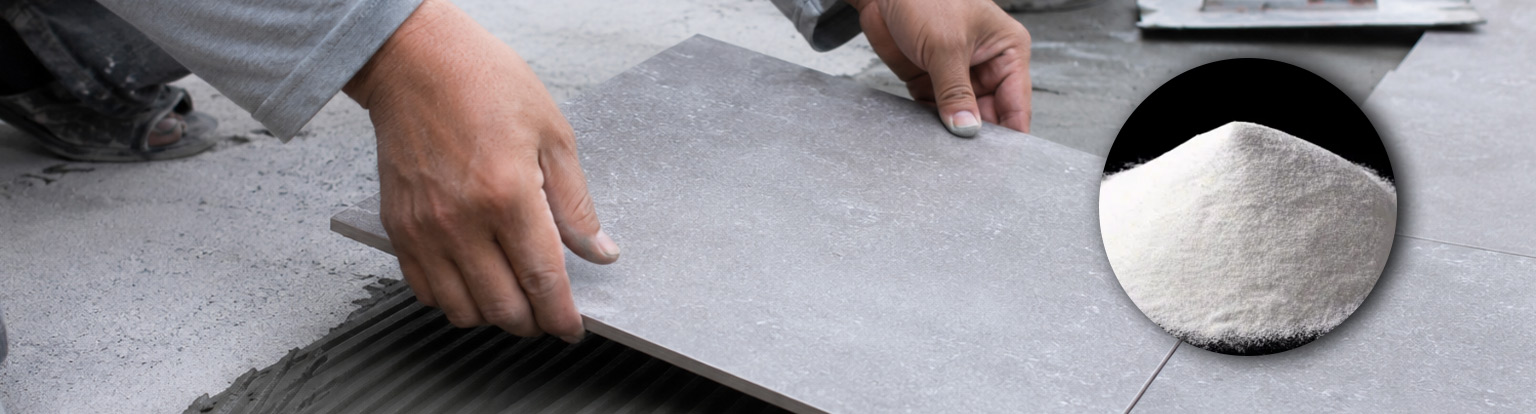
VAE powder for tile adhesive mortar addresses this directly. The polymer film formed by redispersed RDP particles creates chemical adhesion to smooth and low-absorption surfaces that cement chemistry alone cannot achieve. Tensile bond strength of RDP-modified tile adhesive mortar typically reaches 0.5 to 1.0 MPa or above, meeting EN 12004 Class C2 requirements for improved tile adhesive. For heavy natural stone and large-format porcelain slabs above 60 by 60 centimeters, this bond strength level is the minimum required for safe vertical installation.
Water Absorption and Durability Problems
Unmodified cement mortar is porous and absorbs water readily. In wet area applications such as bathrooms, swimming pools, and external facades exposed to driving rain, water absorption leads to efflorescence, freeze-thaw damage in cold climates, loss of bond strength at the mortar-tile interface, and eventual system failure.
RDP powder reduces the water absorption of hardened mortar by forming a hydrophobic polymer network within the pore structure. At standard dosages of 1 to 3 percent by weight of dry blend, RDP-modified mortar absorbs significantly less water than unmodified equivalents, improving durability in wet and exposed conditions. Hydrophobic grades of RDP powder provide even greater water resistance for applications such as waterproof render, swimming pool tile adhesive, and external wall repair mortar in high-rainfall markets across Southeast Asia and South Asia.
Workability and Sag Resistance on Vertical Surfaces
Applying tile adhesive to vertical walls requires mortar that holds its position after troweling without slumping before tiles are placed. Unmodified mortars either lack the cohesion to support tile weight or require excessive water addition that compromises final bond strength and increases shrinkage cracking risk.
RDP powder improves the thixotropic behavior and sag resistance of tile adhesive mortar, allowing application at the correct consistency for full substrate coverage without tile slippage. This workability improvement reduces rework rates on vertical tile installations and allows less experienced applicators to achieve the full contact coverage required for structural bond integrity.
Selecting the Right RDP Powder Grade
Different construction applications require different RDP powder grades. Rigid grades are used in tile adhesive and repair mortar where maximum compressive strength is the priority. Flexible grades are specified for EIFS base coat, crack repair mortar, and joint fillers where deformability is the primary requirement. Semi-flexible grades balance strength and flexibility for general-purpose tile adhesive and wall putty applications. Hydrophobic grades are used specifically in waterproof mortar, swimming pool adhesive, and external render systems where water resistance is the defining performance criterion.
Dosage typically ranges from 1 to 5 percent by weight of dry blend depending on the application. Higher dosages increase flexibility and bond strength but also increase material cost, so correct grade selection at the lowest effective dosage is the approach EastChem technical support recommends to dry mortar producers optimizing their formulations.
Why EastChem
EastChem is a trusted dry mix mortar flexibility additive supplier providing Redispersible Polymer Powder CAS 24937-78-8 to dry mortar manufacturers, construction chemical producers, and distributors in over 150 countries since 2012. Our manufacturing is certified under ISO 9001, ISO 14001, and ISO 45001 systems, and our products meet REACH compliance requirements for European market access.
We supply RDP powder in rigid, flexible, semi-flexible, and hydrophobic grades with ash content, redispersibility, and film formation properties tested on every production batch. Minimum order quantity starts from 1000 kg. Technical data sheets, safety data sheets, and formulation guidance are provided as standard.
Contact EastChem today to request a free sample of RDP powder for your tile adhesive, EIFS, repair mortar, or wall putty formulation, or to discuss pricing and supply terms for your production requirements.