


Solving Tile Adhesive Delamination with VAE Redispersible Polymer Powder CAS 24937-78-8
A dry mix mortar manufacturer based in Ho Chi Minh City, Vietnam was producing a range of tile adhesive products for distribution across residential and commercial construction projects in Southern Vietnam and neighboring markets. Their standard tile adhesive was their highest-volume product, accounting for over 60 percent of total production output. It was also generating their most serious customer complaint: tiles debonding from facade and floor surfaces within six to eighteen months of installation.
The Challenge
Site investigations across three projects where debonding had been reported identified a consistent failure pattern. The tile adhesive was fracturing cohesively within the mortar layer rather than at the mortar-tile or mortar-substrate interface. This cohesive failure pattern indicated that the mortar itself was cracking under thermal cycling stress, not that the bond to the tile or substrate was inadequate. The adhesive was too rigid to accommodate the daily thermal movement of facade tiles exposed to direct sunlight in the high-temperature, high-humidity climate of Southern Vietnam where surface temperatures on west-facing facades regularly exceeded 55 degrees Celsius during afternoon hours.
The manufacturer's existing formulation used a standard RDP powder grade with glass transition temperature above 20 degrees Celsius, sourced from a local distributor. This rigid grade was appropriate for interior floor tile adhesive where thermal movement is minimal, but produced a cured mortar that was too brittle for exterior facade applications where daily thermal cycling generates repeated tensile stress at the adhesive layer. At Tg above 20 degrees Celsius, the polymer film within the mortar becomes fully rigid at temperatures below that threshold, losing its crack-bridging function precisely when thermal contraction stress is highest during cool nighttime hours after hot daytime surface temperatures.
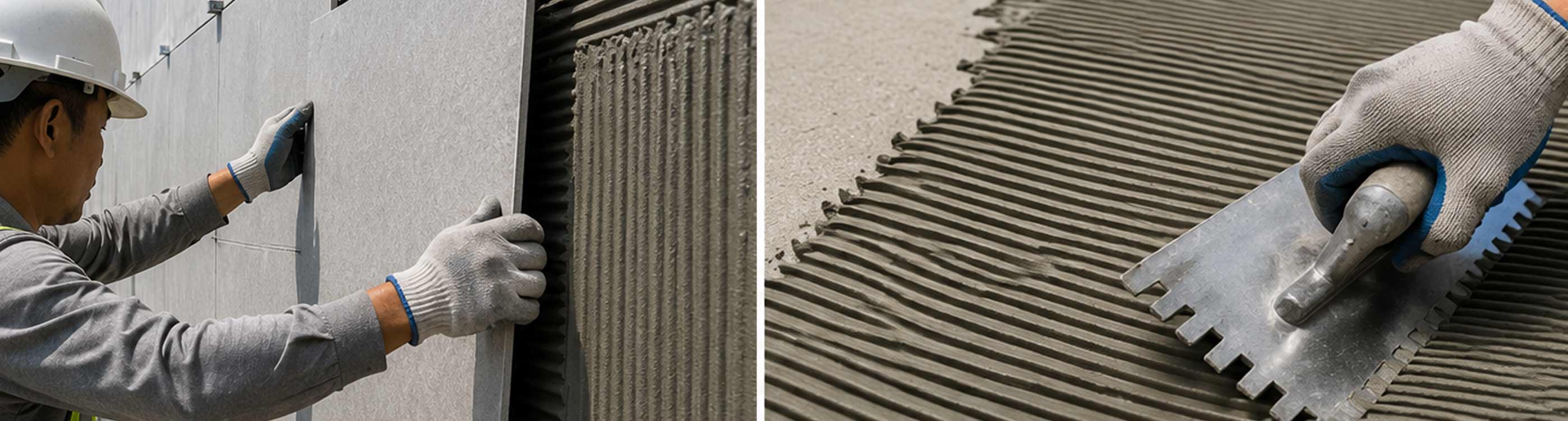
The distributor had supplied the same grade for all tile adhesive applications without differentiating between interior floor and exterior facade requirements, and the manufacturer had not been aware that different RDP grades were required for these two application environments.
The Solution
After contacting EastChem, the technical team identified the root cause within the first consultation and recommended switching to a flexible grade VAE Redispersible Polymer Powder CAS 24937-78-8 with glass transition temperature between 0 and 10 degrees Celsius for the exterior facade tile adhesive formulation, while retaining the existing rigid grade for interior floor tile adhesive where compressive strength was the priority.
EastChem supplied trial quantities of the flexible grade RDP powder for tile adhesive mortar along with technical documentation covering Tg, ash content, redispersibility, and film formation properties. The manufacturer reformulated their exterior tile adhesive variant using the flexible grade at a dosage of 3 percent by weight of dry blend, increased from the previous 2 percent dosage of the rigid grade, to achieve the target bond strength of 0.5 MPa and flexibility profile required for facade applications in the Vietnamese climate.
Parallel formulation trials confirmed that the flexible grade RDP at 3 percent dosage produced tile adhesive with tensile bond strength of 0.6 MPa after standard curing, 0.5 MPa after water immersion, and 0.4 MPa after freeze-thaw cycling, all meeting or exceeding EN 12004 Class C2 requirements for improved tile adhesive in exterior applications. Accelerated thermal cycling tests on bonded tile assemblies showed no cohesive fracture within the adhesive layer after 50 cycles between 5 and 60 degrees Celsius, compared to visible micro-cracking after 20 cycles with the previous rigid grade formulation.
The Results
The manufacturer launched the reformulated exterior tile adhesive under a new product designation within three months of completing the formulation trials. The product was positioned specifically for facade and exterior applications and priced at a modest premium over the standard interior grade, reflecting the higher RDP dosage and flexible grade specification.
Within the first year of commercial launch, no debonding complaints were received from projects using the reformulated exterior product. The manufacturer subsequently expanded distribution of the exterior grade into the Indonesian market, where similar high-temperature facade conditions create the same thermal cycling challenges. They established a quarterly supply agreement with EastChem covering flexible grade RDP powder supplier for dry mortar manufacturer requirements across both product lines, with technical support included for future formulation development as new product variants were added to the range.
The flexible dry mortar additive for tile bonding supplied by EastChem also allowed the manufacturer to confidently recommend their exterior tile adhesive for large-format porcelain tile installations above 60 by 60 centimeters on facade applications, a market segment they had previously avoided due to the bond failure risk with their previous formulation.
What the Customer Said
"We did not know that exterior and interior tile adhesive needed different RDP grades. EastChem identified the problem immediately and gave us the technical solution. Since the reformulation, our facade tile adhesive has performed without complaint across multiple large projects in Vietnam and Indonesia."
Technical Director, Dry Mix Mortar Manufacturer, Ho Chi Minh City, Vietnam
FAQ
What RDP powder Tg is required for exterior facade tile adhesive in hot climates?
For exterior facade tile adhesive in Southeast Asian markets where daily surface temperature swings exceed 40 degrees Celsius, flexible grade RDP powder with glass transition temperature between 0 and 10 degrees Celsius is required. Rigid grades with Tg above 15 degrees Celsius become brittle during cool nighttime hours and lose their crack-bridging function under thermal contraction stress, leading to cohesive fracture within the adhesive layer over time.
What is the difference between interior and exterior tile adhesive RDP grade requirements?
Interior floor tile adhesive in climate-controlled environments experiences minimal thermal cycling and prioritizes compressive strength and water resistance. Semi-flexible or rigid RDP grades at Tg 10 to 20 degrees Celsius are appropriate. Exterior facade tile adhesive experiences daily and seasonal thermal cycling that requires flexible grade RDP at Tg 0 to 10 degrees Celsius to maintain crack resistance and bond integrity across the full temperature range the facade surface experiences in service.
Can EastChem supply both rigid and flexible RDP powder grades for different product lines?
Yes. EastChem supplies VAE Redispersible Polymer Powder CAS 24937-78-8 in rigid, semi-flexible, flexible, and hydrophobic grades to allow dry mortar manufacturers to specify the correct grade for each product in their range. Batch certificates covering Tg, ash content, and redispersibility are provided as standard for every grade and every shipment.