


Hydroxypropyl Methyl Cellulose CAS 9004-65-3: The Critical Additive for High-Performance Self-Leveling Compound
2026-06-11 17:50A self-leveling compound that bubbles, cracks, or fails to flow evenly across the floor surface is not a minor inconvenience. It means ripping out the entire pour, grinding the substrate, and starting over. For flooring contractors and dry mortar manufacturers across Southeast Asia, Europe, and Asia, the cost of a failed self-leveling pour is measured in wasted material, lost labor, project delays, and damaged customer relationships. In most cases, the failure traces back to one incorrectly specified or inconsistently supplied ingredient: Hydroxypropyl Methyl Cellulose.
What Is HPMC for Self-Leveling Compound
Hydroxypropyl Methyl Cellulose, universally known as HPMC, carries CAS number 9004-65-3. It is a non-ionic cellulose ether produced from natural cotton cellulose through alkalization and etherification. In self-leveling compound formulations, HPMC serves a precise and demanding role that differs significantly from its function in tile adhesive or wall plaster.
Self-leveling compound requires a paradoxical combination of properties: extremely high initial flowability so the material spreads and levels under gravity without mechanical assistance, combined with sufficient body and viscosity to prevent bleeding, segregation, and surface cratering as the material settles. HPMC is the additive that balances these two competing requirements simultaneously. No other single additive replicates this function in a cementitious or gypsum-based self-leveling system.
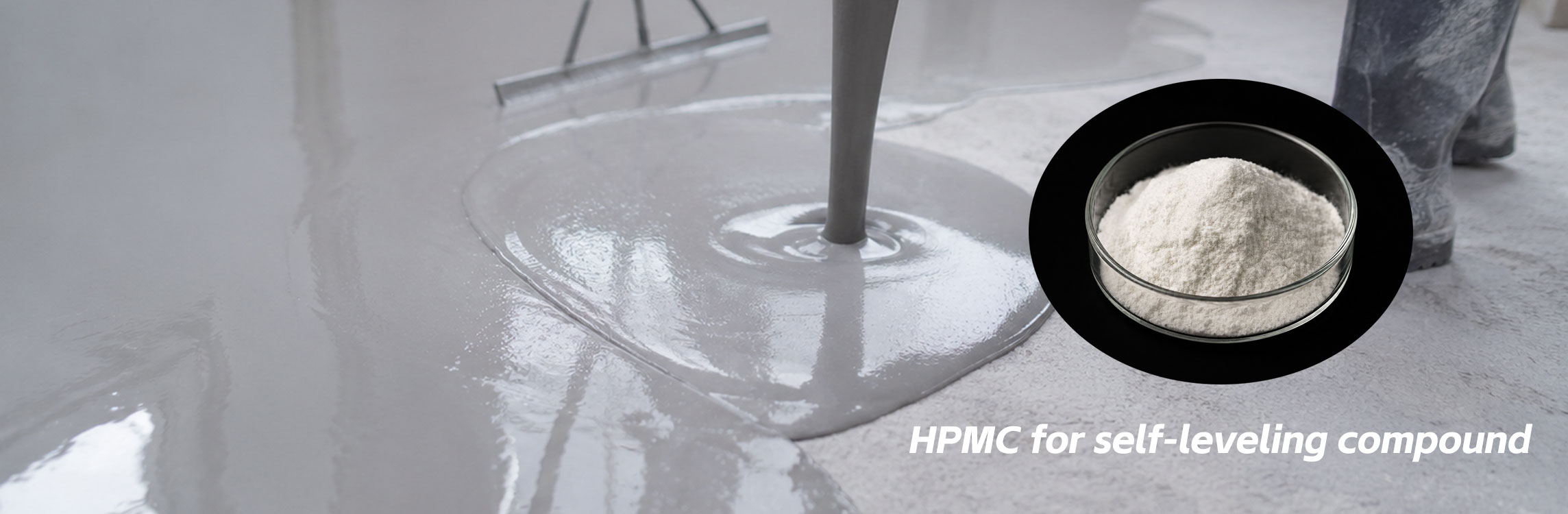
The specific HPMC grades used in self-leveling compound formulations are low to medium viscosity, typically between 400 and 4000 mps. This is significantly lower than the grades used in tile adhesive or render, where viscosity of 40000 to 75000 mps is standard. Using the wrong viscosity grade in a self-leveling application is one of the most common formulation errors made by dry mortar producers entering this product category for the first time.
Why HPMC Grade Selection Determines Self-Leveling Performance
Flow and Self-Leveling Ability
The primary function of a self-leveling compound is to flow freely across an uneven substrate and produce a flat, smooth surface without troweling. This requires a flow value of 230 to 280 mm measured by the EN 13813 flow table test at the recommended water addition rate.
HPMC for self-leveling compound at the correct low-viscosity grade provides just enough thickening to stabilize the mix without restricting flow. At dosages of 0.05 to 0.15 percent by weight of dry blend, low-viscosity HPMC maintains the water within the mix, prevents premature stiffening, and allows the surface tension forces that drive self-leveling behavior to operate freely. Exceeding this dosage range or using a higher viscosity grade immediately restricts flow below the minimum required for satisfactory leveling, resulting in a surface that requires manual spreading and loses the self-leveling function entirely.
Bleeding and Segregation Control
A self-leveling compound with insufficient viscosity control bleeds free water to the surface during the first 10 to 30 minutes after placement. This bleed water creates a weak, dusty surface layer as it evaporates, reduces the effective water-cement ratio in the lower portion of the pour, and causes differential strength development between the surface and the body of the screed. The result is a floor surface that delaminate under foot traffic or wheeled loads within weeks of installation.
HPMC as a self-leveling floor compound additive prevents bleeding by retaining water uniformly throughout the mix matrix. The water retention function of HPMC ensures that the mix remains homogeneous from placement to initial set, producing a consistent surface strength that matches the body strength of the screed.
Surface Cratering and Pin-Hole Defects
Air entrapped during mixing escapes through the surface of a self-leveling compound during the leveling phase. If the surface viscosity is too low, escaping air bubbles collapse and leave open craters or pin holes in the finished surface. These defects require sanding or skim coating before floor coverings can be applied, adding labor cost and project time.
HPMC at the correct dosage and grade provides sufficient surface film stability to allow air bubbles to escape cleanly without leaving surface defects. Combined with appropriate defoamer selection in the formulation, HPMC contributes to the smooth, defect-free surface finish that distinguishes a professional-grade self-leveling compound from a budget formulation.
Compatibility With Cement and Gypsum Based Systems
Self-leveling compounds are formulated on either cement, gypsum, or blended cement-gypsum binder systems depending on the application. Cement-based systems are used for exterior and wet area applications. Gypsum-based systems are preferred for interior residential and commercial flooring where faster strength development and smoother surface finish are priorities.
HPMC CAS 9004-65-3 is compatible with both binder systems. In gypsum-based self-leveling compounds, low-viscosity HPMC grades improve workability and extend the working time window without the excessive retardation that higher viscosity grades can cause in sulfate-rich gypsum systems. In cement-based systems, HPMC improves water retention during the critical early hydration period, ensuring full strength development at the specified water addition rate.
For dry mortar manufacturers in Vietnam, Thailand, India, Turkey, Poland, and other active flooring markets, having a cellulose ether for flooring mortar supplier who understands both binder systems and can recommend the correct HPMC grade for each is essential to formulation success.
Why EastChem
EastChem supplies Hydroxypropyl Methyl Cellulose CAS 9004-65-3 in a full range of viscosity grades including low-viscosity grades specifically suited for self-leveling compound formulations. Our manufacturing is certified under ISO 9001, ISO 14001, and ISO 45001 systems, and our products meet REACH compliance requirements for European market access. Viscosity consistency, moisture content, and particle size are tested on every production batch before shipment.
Our technical team provides formulation guidance for both cement-based and gypsum-based self-leveling systems, including recommended HPMC grade, dosage range, and compatibility with other additives such as RDP powder, defoamer, and retarder. Qualified buyers can request a free sample of HPMC for self-leveling compound before committing to a supply contract.
Contact EastChem today to request a sample, technical data sheet, or pricing for Hydroxypropyl Methyl Cellulose CAS 9004-65-3 for your self-leveling compound formulation.