


Hydroxypropyl Methyl Cellulose Selection Guide: Viscosity Grades, Substitution Degrees, and Application Matching for Construction Products
2026-07-21 16:30Hydroxypropyl Methyl Cellulose is not one product. It is a family of products differentiated by viscosity grade, degree of methyl substitution, degree of hydroxypropyl substitution, particle size, and surface treatment. Buying the wrong grade produces mortar that is too stiff, too thin, cracks during drying, or loses workability before application is complete. For dry mix mortar manufacturers, construction chemical formulators, and importers sourcing HPMC across Southeast Asia, Europe, and Asia, this guide explains what each parameter means in practical terms and how to match the correct grade to each construction application.

What Parameters Define HPMC Grades
Viscosity
Viscosity is the most commonly specified parameter for HPMC in construction applications. It is measured in millipascal seconds at 2 percent solution concentration and 20 degrees Celsius. Commercial grades range from 400 mps to 200000 mps, with construction applications typically falling between 5000 and 100000 mps.
Higher viscosity provides stronger water retention, longer open time, and greater thickening effect at the same dosage. Lower viscosity provides faster dissolution, lower water demand, and better flowability in fluid mortar systems. Selecting viscosity based on the target application rather than defaulting to a single grade across all products is the fundamental principle of correct HPMC specification.
Degree of Methyl Substitution
Degree of methyl substitution, abbreviated DS, measures the average number of methyl groups attached per glucose unit of the cellulose backbone. For construction grade HPMC, DS typically ranges from 1.3 to 2.0. Higher DS improves water solubility and increases gel point temperature, which is the temperature at which HPMC solution transitions from liquid to gel. Higher gel point temperature is advantageous in hot climate applications because it maintains water retention performance at elevated substrate temperatures.
Degree of Hydroxypropyl Substitution
Degree of hydroxypropyl substitution, abbreviated MS, measures the average number of hydroxypropyl groups per glucose unit. MS typically ranges from 0.1 to 0.3 for construction grade HPMC. Higher MS improves cold water solubility and reduces gelling tendency, which improves dissolution behavior in cold mixing water on winter construction sites across Northern European and Northeast Asian markets.
Surface Treatment
Surface treatment controls dissolution rate. Untreated HPMC dissolves rapidly in cold water but can form lumps during mixing if not dispersed correctly before water contact. Surface-treated HPMC dissolves more slowly and uniformly, preventing lump formation during on-site mixing with standard mixing equipment. For factory-produced dry mix mortar where mixing time is controlled and equipment is consistent, surface-treated grades ensure uniform HPMC distribution throughout the mortar matrix regardless of operator technique.
How to Match HPMC Grade to Construction Application
Tile Adhesive
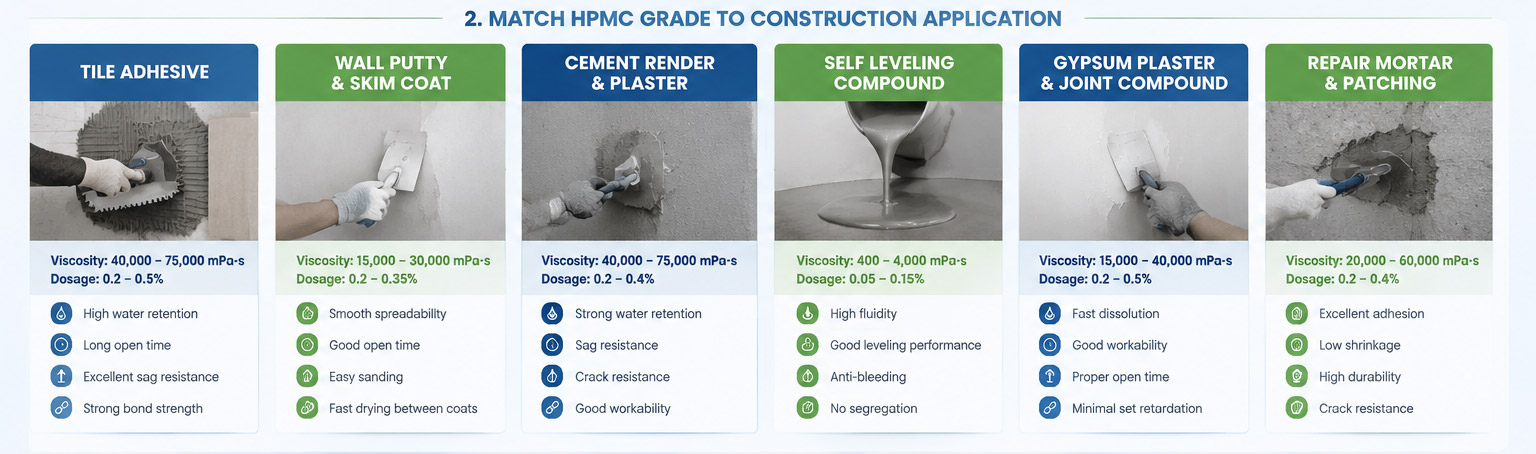
Tile adhesive requires high water retention for open time, sag resistance for vertical surface application, and adequate bond strength development during setting. Hydroxypropyl methyl cellulose viscosity grades for construction tile adhesive applications range from 40000 to 75000 mps. Standard ceramic tile adhesive uses 40000 to 60000 mps at dosage of 0.2 to 0.35 percent. Heavy duty tile adhesive for large format porcelain and natural stone uses 60000 to 75000 mps at dosage of 0.3 to 0.5 percent for additional sag resistance under heavier tile weight.
Wall Putty and Skim Coat
Wall putty requires smooth spreadability, adequate open time for large wall area application, and fast enough drying for multiple coat finishing within a working day. Viscosity grades of 15000 to 30000 mps at dosage of 0.2 to 0.35 percent provide the balanced workability and drying speed required. Higher grades above 40000 mps produce excessive stiffness in wall putty and slow drying between coats.
Cement Render and Plaster
Exterior cement render requires strong water retention for thick coat application of 8 to 20 mm, sag resistance for vertical surface stability, and crack resistance during curing. Viscosity grades of 40000 to 75000 mps at dosage of 0.2 to 0.4 percent are standard. For spray-applied render and hot climate applications above 35 degrees Celsius, grades of 60000 to 75000 mps at dosage of 0.3 to 0.4 percent provide the extended open time and water retention required.
Self Leveling Compound
Self leveling compound requires high fluidity for gravity leveling behavior combined with just enough viscosity to prevent bleeding and segregation. Low viscosity grades of 400 to 4000 mps at dosage of 0.05 to 0.15 percent provide the minimum required thickening without restricting the flow that defines self leveling performance. Higher viscosity grades in self leveling compound restrict flow below the minimum required for satisfactory leveling.
Gypsum Plaster and Joint Compound
Gypsum based products require HPMC grades that dissolve rapidly in mixing water without retarding gypsum set time significantly. Viscosity grades of 15000 to 40000 mps at dosage of 0.2 to 0.5 percent are standard for gypsum plaster. Joint compound uses 10000 to 30000 mps depending on coat type. Dosage above 0.5 percent in gypsum systems can cause noticeable set retardation that delays drying between coats.
Concrete Floor Repair Mortar
Concrete repair mortar requires water retention for full cement hydration in thin section repairs, workability for trowel application, and crack resistance under thermal cycling. Viscosity grades of 20000 to 60000 mps at dosage of 0.2 to 0.4 percent cover most repair mortar applications. Rapid setting repair mortar uses lower grades of 15000 to 25000 mps at reduced dosage to avoid set retardation that conflicts with fast strength development requirements.
Full Application Reference Table
| Application | Viscosity Grade | Dosage | Key Property |
|---|---|---|---|
| Standard tile adhesive | 40000-60000 mps | 0.2-0.35% | Open time, sag resistance |
| Heavy duty tile adhesive | 60000-75000 mps | 0.3-0.5% | High sag resistance, bond strength |
| Wall putty | 15000-30000 mps | 0.2-0.35% | Spreadability, fast drying |
| Exterior render standard | 40000-60000 mps | 0.2-0.35% | Water retention, crack resistance |
| Exterior render hot climate | 60000-75000 mps | 0.3-0.4% | Extended open time |
| Self leveling compound | 400-4000 mps | 0.05-0.15% | Flow, bleed control |
| Gypsum plaster | 15000-40000 mps | 0.2-0.4% | Workability, minimal retardation |
| Joint compound taping | 20000-40000 mps | 0.4-0.6% | Open time, tape embedment |
| Concrete repair mortar | 20000-60000 mps | 0.2-0.4% | Water retention, workability |
What to Verify When Sourcing HPMC
Viscosity consistency between batches within 10 percent of stated grade is the most critical incoming quality parameter. A deviation of 20 percent or more changes mortar performance in ways that cannot be reliably compensated by dosage adjustment alone.
Moisture content below 5 percent ensures the powder flows freely in dry blending equipment and disperses uniformly in the dry mortar blend without clumping.
Particle size distribution appropriate for the blending equipment in use ensures uniform HPMC distribution throughout the dry mortar blend. Coarse particle grades may be appropriate for mechanical drum blenders. Fine particle grades are required for ribbon blender and paddle mixer equipment where short blending times limit the degree of mixing achieved.
Why EastChem
EastChem is a trusted HPMC cellulose ether supplier for dry mortar providing Hydroxypropyl Methyl Cellulose CAS 9004-65-3 across the full viscosity range from 400 to 100000 mps to dry mix mortar manufacturers, construction chemical formulators, and importers across global markets. Our manufacturing is certified under ISO 9001, ISO 14001, and ISO 45001 systems, and our products meet REACH compliance requirements for European market access. Viscosity, moisture content, and particle size are tested on every production batch with per-batch certificates provided as standard.
Contact EastChem today to request samples across multiple viscosity grades, technical data sheets, or pricing for your specific application and production volume requirements.
Frequently Asked Questions
What is the difference between HPMC 40000 and HPMC 75000 for tile adhesive?
HPMC 40000 mps provides adequate water retention and open time for standard ceramic tile adhesive in moderate climates and interior applications. HPMC 75000 mps provides stronger water retention and higher sag resistance required for heavy duty tile adhesive for large format tiles above 60 by 60 centimeters on vertical surfaces, and for tile adhesive in hot climates above 35 degrees Celsius where faster evaporation requires stronger water retention to maintain adequate open time.
Can one HPMC grade be used across all dry mortar products in a production facility?
Using a single grade across all products reduces inventory complexity but compromises performance in most applications. A medium viscosity grade of 40000 mps may be acceptable for tile adhesive and render but will produce excessive stiffness in wall putty and completely fail to deliver the flow required for self leveling compound. Correct grade selection for each product line is the approach that produces consistent field performance and minimizes warranty claims from end users.
How does HPMC dissolution speed affect dry mortar performance on site?
HPMC must dissolve fully within the standard on-site mixing time of 2 to 5 minutes to form a uniform water-retaining film throughout the mortar matrix. Surface-treated grades dissolve more rapidly and uniformly than untreated grades and are recommended for applications where mixing time is short or mixing equipment is inconsistent. Incompletely dissolved HPMC leaves undissolved particles that create uneven water retention, granular consistency, and localized cracking in areas of insufficient HPMC concentration.