


How HPMC for Tile Adhesive Solved an Open Time Problem for a Tile Installation Contractor in India
A tile installation contractor operating across multiple large commercial and residential projects in Rajasthan, India was experiencing a consistent and costly problem during the peak summer construction season. Site temperatures regularly reached 38 to 42 degrees Celsius during working hours, and substrate surface temperatures on sun-facing walls exceeded 45 degrees Celsius by midday. Under these conditions, the tile adhesive mortar the contractor was mixing on site was skinning over within 6 to 8 minutes of application, well below the 15 to 20 minute open time required for large-format ceramic and vitrified tile installation.
The Challenge
The contractor was using a locally sourced dry mix tile adhesive from a regional manufacturer. The adhesive performed adequately during the cooler months between November and February but failed consistently from March onward as temperatures rose. Workers were forced to mix smaller batches, work faster, and wet substrates with water before tile placement to compensate for the rapid drying. Despite these adjustments, bond failure rates increased significantly during the summer months, with tiles debonding from facades and floors within three to six months of installation on several project sites.
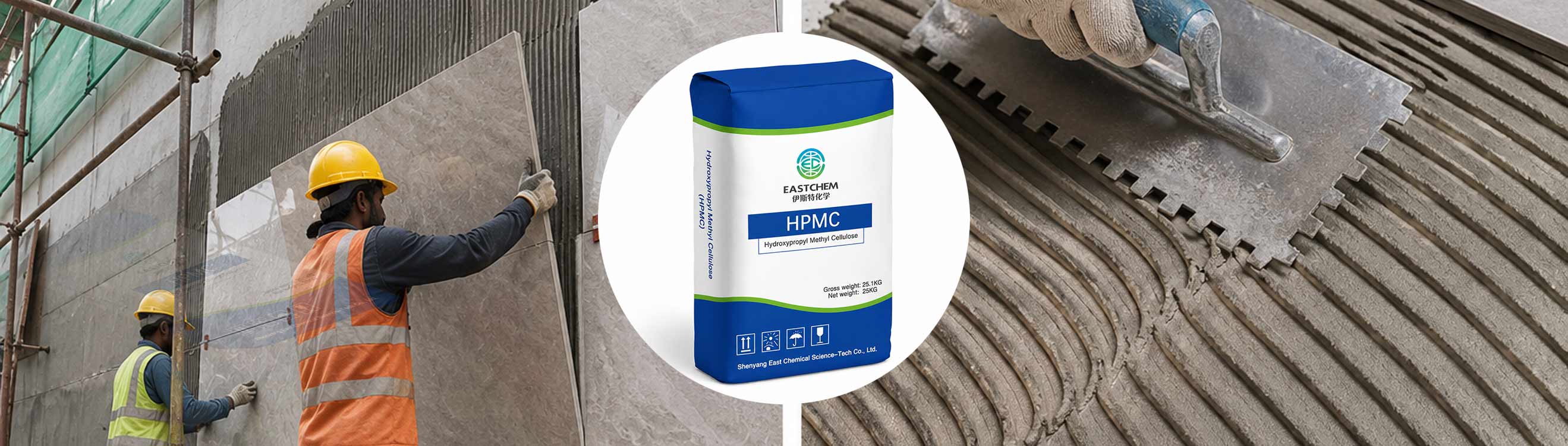
After investigating the problem, the site technical supervisor identified the root cause: the HPMC grade used in the dry mix adhesive formulation had a viscosity of 20000 mps, which was appropriate for moderate climates but provided insufficient water retention under the extreme heat conditions typical of Rajasthan summers. The low viscosity HPMC evaporated mix water too quickly from the adhesive surface, collapsing the open time window before tiles could be properly bedded and adjusted.
The Solution
The contractor brought the problem to their dry mix adhesive supplier, who contacted EastChem for technical support. EastChem recommended switching to a higher viscosity HPMC for tile adhesive, specifically a 60000 mps grade with enhanced water retention properties designed for hot climate applications.
Hydroxypropyl Methyl Cellulose CAS 9004-65-3 at 60000 mps viscosity forms a denser, more stable water-retaining film within the adhesive matrix compared to lower viscosity grades. At the same dosage of 0.3 percent by weight of dry blend, the higher viscosity grade retained significantly more mix water within the adhesive layer during the critical open time window, slowing surface evaporation even under direct sun exposure above 40 degrees Celsius.
EastChem supplied a trial quantity of the 60000 mps HPMC grade along with a technical data sheet and application guidance covering dosage adjustment for high-temperature conditions. The adhesive manufacturer reformulated the hot climate tile adhesive variant using the new HPMC grade without changing any other component of the formulation.
The Results
Field trials across two project sites over four weeks during peak summer confirmed the improvement. Open time extended from 6 to 8 minutes with the previous grade to 18 to 22 minutes with EastChem HPMC 60000 mps, consistently across different substrate types including concrete block, brick, and cement render. Workers were able to apply adhesive at a normal pace, adjust tile positions without rushing, and achieve full contact coverage above the 80 percent minimum required for facade and floor installations.
Bond failure complaints on summer projects dropped to near zero in the following construction season. The adhesive manufacturer added the hot climate variant as a permanent product line item, marketed specifically for summer use in North and Central India, and established a regular supply agreement with EastChem as their HPMC cellulose ether supplier for tile installation applications.
The tile installation contractor reported that material waste from discarded batches decreased by over 60 percent during the summer months, directly improving project margins on labor-intensive large-format tile work.
What the Customer Said
"We had accepted summer tile failures as a seasonal problem we could not solve. Switching to the right HPMC grade changed the adhesive behavior completely. The mortar now stays workable through the hottest part of the day, and we have not had a bond failure complaint since the reformulation."
Site Technical Supervisor, Tile Installation Contractor, Rajasthan, India
Frequently Asked Questions
What HPMC viscosity grade is recommended for tile adhesive in hot climates?
For tile adhesive applications in high-temperature markets such as India, Pakistan, the Middle East, and Southeast Asia where ambient temperatures regularly exceed 35 degrees Celsius, viscosity grades between 50000 and 75000 mps are recommended as a tile adhesive open time extender. Lower viscosity grades suitable for temperate climates provide insufficient water retention under sustained heat exposure and should be upgraded when products are formulated for hot climate markets.
How does HPMC viscosity affect open time in tile adhesive?
Higher HPMC viscosity produces a denser water-retaining film within the adhesive matrix, slowing the rate of evaporative water loss from the adhesive surface after application. At equivalent dosage, increasing HPMC viscosity from 20000 to 60000 mps typically extends open time by 8 to 15 minutes depending on ambient temperature, substrate absorption, and air movement on site. This extension is the primary reason hot climate tile adhesive formulations specify higher viscosity grades than standard temperate formulations.
What dosage of HPMC is used in tile adhesive for large-format tiles?
For standard ceramic tile adhesive, HPMC dosage ranges from 0.2 to 0.35 percent by weight of dry blend. For heavy-duty tile adhesive designed for large-format porcelain tiles above 60 by 60 centimeters or natural stone, dosage increases to 0.3 to 0.5 percent to provide the additional sag resistance required for vertical surface installation without tile slippage before adhesive sets.
Can EastChem provide HPMC samples for tile adhesive reformulation trials?
Yes. EastChem provides samples of Hydroxypropyl Methyl Cellulose CAS 9004-65-3 across multiple viscosity grades to qualified buyers for formulation testing and climate-specific performance evaluation. Contact our technical team with your current formulation details, target market climate conditions, and performance requirements to receive grade recommendations and sample quantities for trial mixing.