


Magnesium Phosphate Cement: The Rapid Hardening Repair Material That Outperforms Portland Cement in Every Time-Critical Application
2026-06-15 15:30When a concrete structure needs to return to service in hours rather than days, standard Portland cement is the wrong material. It cannot reach structural strength in under 24 hours. It cannot harden at sub-zero temperatures. It cannot bond reliably to existing concrete at the tensile strength levels required for structural repair. Magnesium Phosphate Cement solves all three of these limitations simultaneously, making it the standard rapid hardening repair material for infrastructure, industrial, and cold-climate construction applications worldwide.
What Is Magnesium Phosphate Cement
Magnesium Phosphate Cement, widely abbreviated as MPC rapid hardening repair material, is a magnesium oxide potassium phosphate cement system formed by the reaction between magnesium oxide and monopotassium phosphate. The acid-base reaction between these two components produces a crystalline magnesium potassium phosphate hydrate matrix with exceptional early strength, dimensional stability, and bond to both concrete and steel substrates.
The composition of MPC is straightforward: magnesium oxide and monopotassium phosphate as the primary reactive components. This simple, well-defined chemistry produces a binder system with highly predictable performance across a wide range of application conditions. The pH of freshly mixed MPC is approximately 9, and the material reaches a neutral pH of approximately 7 at final set, which is significantly less alkaline than Portland cement at pH 12 to 13. This near-neutral final pH means MPC is compatible with a wider range of substrates and poses lower chemical risk to embedded steel and adjacent materials than conventional cementitious systems.
MPC can be applied as neat paste, mortar with fine aggregate, or concrete with coarse aggregate depending on the repair volume and structural requirements. Setting time is controllable: 10 to 20 minutes for small repairs and detail work, and 25 minutes or more for large-volume placements where extended working time is required.
Key Performance Advantages
Early and Long-Term Strength
The compressive strength development of Magnesium Phosphate Cement is unmatched by any Portland cement-based system. Standard grade MPC reaches 30 MPa at 1.5 hours, 55 MPa at 1 day, and 75 MPa at 28 days. High-strength grades achieve compressive strength up to 100 MPa at 28 days, making MPC suitable for structural repair applications where the original concrete was specified at high strength grades. This rapid strength development allows repaired infrastructure to return to full service load within 0.5 to 3 hours of repair completion, a performance level that standard repair mortars cannot approach.
Dimensional Stability
MPC exhibits approximately 0.1 percent volumetric expansion after hardening. This slight controlled expansion is a significant advantage over Portland cement-based repair mortars, which shrink during curing and develop tensile stress at the repair-substrate interface. The slight expansion of MPC maintains intimate contact with the substrate throughout the curing process, contributing to the high bond strength of 3.5 MPa to existing concrete that characterizes properly placed MPC repairs.
Cold Weather Performance
MPC hardens normally at temperatures as low as minus 20 degrees Celsius without heating equipment, insulated curing blankets, or chemical antifreeze admixtures. Portland cement hydration slows dramatically below 5 degrees Celsius and essentially stops at or below zero. For infrastructure maintenance contractors operating in Northern European markets, Central Asian high-altitude environments, and winter construction programs across Northeast Asia, MPC eliminates the seasonal operational limitations that Portland cement systems impose.
Bond Strength to Concrete and Steel
MPC as a rapid setting mortar for concrete repair achieves bond strength to existing concrete substrate of 3.5 MPa and tensile bond to steel above 1.0 MPa. These values exceed the minimum bond strength requirements for structural concrete repair under EN 1504 and comparable international standards. For post-installed rebar anchoring, equipment base grouting, and structural joint repair where load transfer between the repair material and substrate is critical, MPC bond performance provides the structural reliability that epoxy-based systems cannot deliver at elevated temperatures.
Core Applications
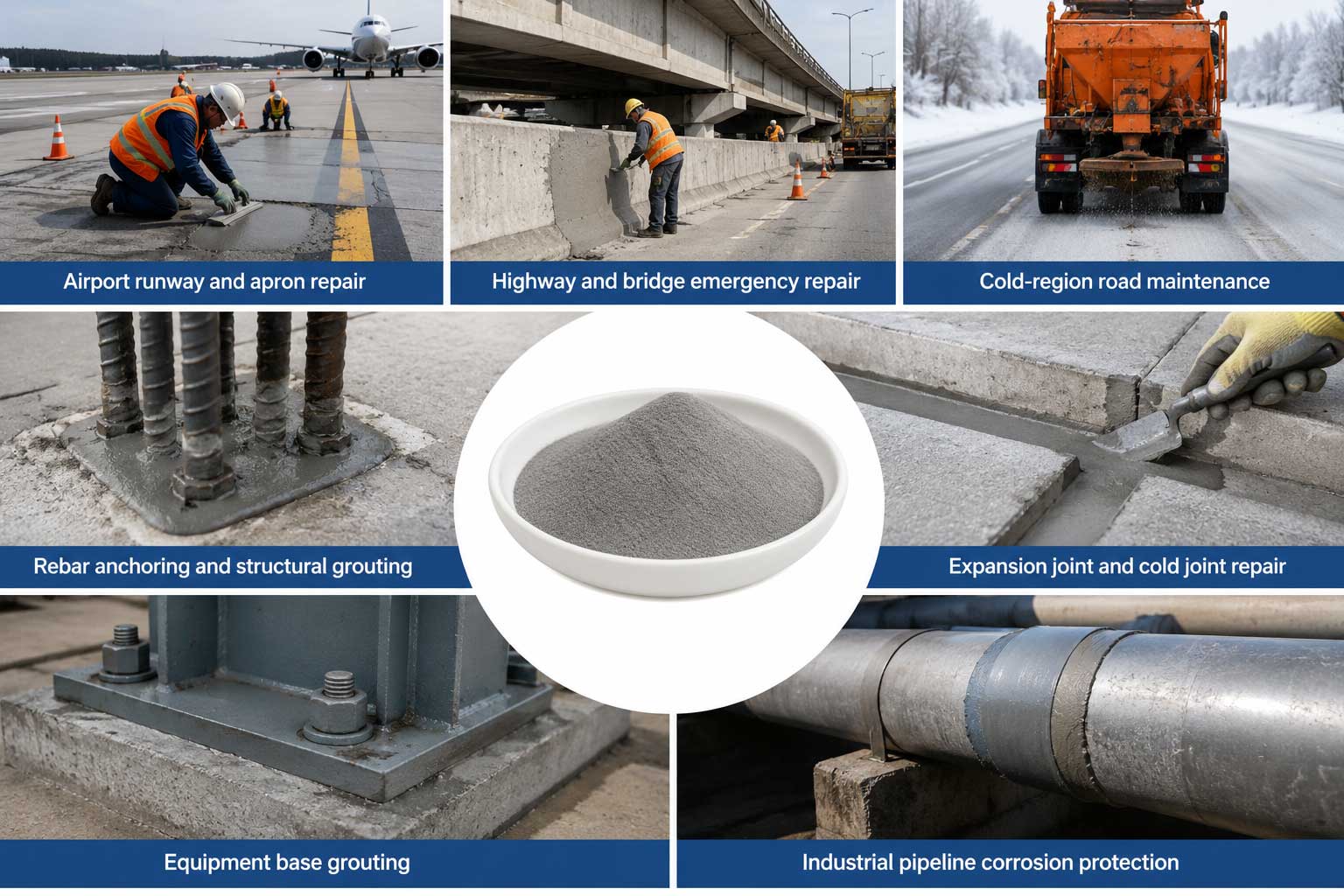
Airport runway and apron repair, highway and bridge emergency repair, cold-region road maintenance, rebar anchoring and structural grouting, expansion joint and cold joint repair, and industrial pipeline corrosion protection all represent established applications for MPC across Southeast Asia, Europe, and Asia. In each of these applications, the combination of rapid strength development, cold weather performance, and superior bond strength makes MPC the technically correct and operationally efficient material choice.
EastChem is a trusted magnesium phosphate binder supplier providing Magnesium Phosphate Cement to infrastructure contractors, road maintenance companies, precast producers, and industrial facility operators across global markets. Our manufacturing is certified under ISO 9001, ISO 14001, and ISO 45001 systems, and our products meet REACH compliance requirements for European market access.
We supply MPC in standard and high-strength grades with full technical documentation including mix design guidance, setting time adjustment instructions, and substrate preparation requirements. Qualified buyers can request a product sample and technical data sheet before committing to a supply contract.
Contact EastChem today to request a sample, technical data sheet, or pricing for Magnesium Phosphate Cement for your repair or construction project.
Frequently Asked Questions
What is Magnesium Phosphate Cement made of?
MPC consists of two primary components: magnesium oxide and monopotassium phosphate. The rapid acid-base reaction between these two materials produces a crystalline magnesium potassium phosphate hydrate matrix that gives MPC its characteristic early strength and dimensional stability.
What is the pH of MPC during mixing and after hardening?
The pH of freshly mixed MPC is approximately 9. After final set, the pH stabilizes at approximately 7, which is near neutral. This is significantly lower than Portland cement, which maintains a pH above 12 throughout its service life.
Can MPC be used if it was stored at minus 15 degrees Celsius?
No. If the product has been stored at minus 15 degrees Celsius, it cannot be used directly. For testing or application in minus 15 degree conditions, the product must be placed at that temperature one day in advance to allow full temperature equilibration before mixing and placement.
What compressive strength does MPC reach at 28 days?
Standard grade MPC reaches 75 MPa at 28 days. High-strength grades achieve up to 100 MPa at 28 days. Both grades exceed 30 MPa at 1.5 hours, allowing repaired structures to return to service within hours of repair completion.
Does MPC expand or shrink after hardening?
MPC exhibits approximately 0.1 percent volumetric expansion after hardening. This controlled slight expansion maintains contact with the substrate during curing and contributes to the high bond strength of MPC to existing concrete surfaces.