

Hydroxypropyl Methyl Cellulose for Wall Putty in Southeast Asia
In Southeast Asian countries such as Indonesia, Vietnam, Thailand, and the Philippines, wall putty and skim coat are widely used in residential and commercial construction. However, due to high temperature, strong sunlight, and variable humidity, manufacturers and contractors often face serious quality issues.
Common problems include:
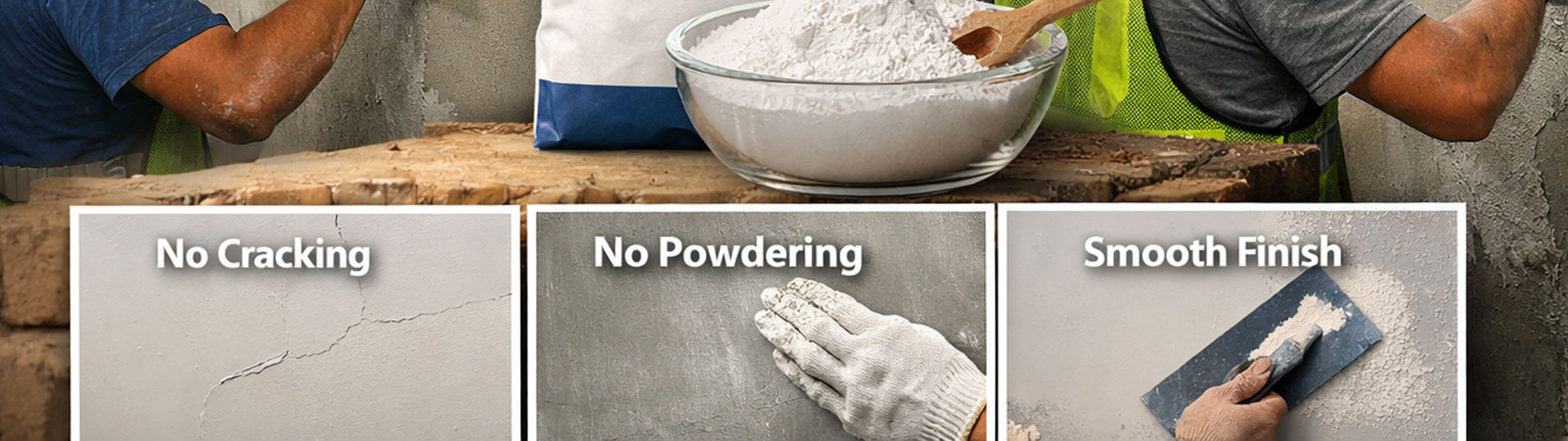
Cracking caused by rapid water evaporation
Powdering due to insufficient cement hydration
Poor workability, making application slow and inconsistent
To address these challenges, a local wall putty manufacturer introduced Hydroxypropyl Methyl Cellulose for Wall Putty into their formulation.
Project Goal
The objective of this project was to improve both product performance and on-site construction efficiency by using a suitable HPMC for Wall Putty, specifically designed for tropical construction conditions.
Key requirements included:
Strong water retention under high temperature
Smooth and stable workability
Reduced surface defects after drying
Solution: Construction Grade HPMC for Wall Putty & Skim Coat
After formulation trials, the manufacturer selected Construction Grade HPMC as the core functional additive.
Why HPMC Powder for Wall Putty Was Chosen
Excellent water retention to slow evaporation
Stable viscosity for consistent mixing
Good compatibility with cement and fillers
By incorporating HPMC Powder for Wall Putty, the wall putty system became more robust and adaptable to Southeast Asia’s climate.
Performance Improvement with HPMC for Skim Coat
1. Cracking Control in Hot Conditions
Hydroxypropyl Methyl Cellulose for Wall Putty effectively retained moisture during curing, allowing full cement hydration even under strong sunlight.
Result:
Significant reduction in surface cracking
Improved long-term durability for both interior and exterior walls
2. Reduced Powdering and Stronger Surface
Before using HPMC for Wall Putty, the dried surface often showed chalking and dusting.
After optimization with Construction Grade HPMC, surface cohesion improved noticeably.
Result:
Less powdering after drying
Cleaner and stronger wall surfaces
3. Improved Workability and Application Efficiency
By applying HPMC for Skim Coat, contractors experienced smoother spreading and easier troweling.
Result:
No dragging or tearing during application
Better surface flatness
Higher daily construction output
Application Scope
This solution was successfully applied to:
Interior wall putty
Exterior wall putty
Cement-based skim coat systems
In all cases, Hydroxypropyl Methyl Cellulose for Wall Putty played a decisive role in quality improvement.
Customer Feedback
After switching to HPMC Powder for Wall Putty, the manufacturer reported:
Fewer customer complaints
Improved product consistency
Stronger competitiveness in the local market
The optimized formulation allowed the company to position its wall putty products as more stable and construction-friendly, especially for tropical environments.
Conclusion
This Southeast Asia case demonstrates that Hydroxypropyl Methyl Cellulose for Wall Putty is a reliable and effective solution for cracking, powdering, and poor workability in challenging climates.
By choosing the right Construction Grade HPMC and applying it correctly in wall putty and skim coat systems, manufacturers can achieve consistent quality and better construction performance.
For tropical regions, HPMC for Wall Putty and HPMC for Skim Coat are no longer optional additives—they are essential performance enhancers.