


- Home
- >
News
Concrete floors are specified for their strength and durability. The reality on most construction sites is that the finished floor surface — the zone that actually contacts traffic, chemicals, and cleaning equipment — is significantly weaker than the concrete below it. This surface weakness is not a quality control failure. It is chemistry. And Lithium Silicate is the chemical solution.
Most concrete floor problems get treated with coatings. Epoxy, polyurethane, acrylic sealer — layer after layer applied over a surface that was never properly hardened in the first place. The coatings wear through. The floor dusts again. Another contractor is called, another coating is specified, and the cycle repeats every three to five years at significant cost. If this is your situation, the coating is not the problem. The surface is. And Lithium Silicate is the solution that addresses it permanently — from the inside out, not the surface down.
Concrete floors fail in predictable ways. Dusting under forklift traffic. Surface abrasion in high-footfall retail environments. Moisture vapor transmission causing adhesive failure under flooring finishes. In every case, the underlying cause is the same: a porous, under-dense surface layer that lacks the hardness and impermeability the application demands. Lithium silicate concrete densifier addresses all three failure modes through a single penetrating treatment — and unlike surface coatings, it does so permanently.
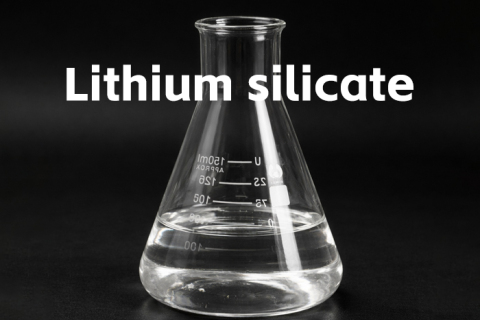
In modern construction, concrete durability and surface performance have become critical evaluation standards. Traditional concrete surfaces often suffer from dusting, abrasion, cracking, and chemical attack over time. To address these issues, Lithium Silicate has emerged as a high-performance solution for concrete densification and surface hardening.
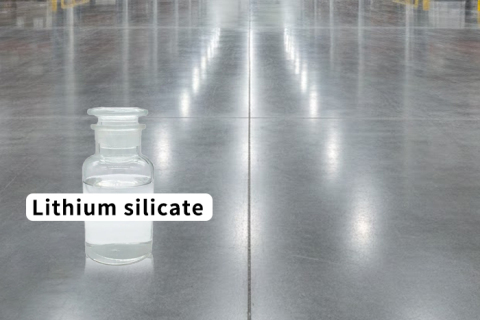
As the global construction industry shifts towards sustainable and low-maintenance infrastructure, the demand for advanced chemical treatments has reached a new peak. Today, Lithium Silicate stands at the forefront of this evolution, offering a superior alternative to traditional sodium-based solutions.
Concrete is an indispensable and important material in construction projects, and its performance directly affects the quality of the project. In recent years, researchers have discovered that adding lithium silicate to concrete mortar can significantly improve the strength, durability and crack resistance of concrete.
Lithium silicate, also known as lithium water glass, is a compound formed by the combination of metallic lithium and silicate structure, with the molecular formula Li2SiO3. Lithium silicate is a odorless, odorless, transparent liquid with a pH value of around 11 and is alkaline. Soluble in water and alkaline solutions, but insoluble in alcohols and organic solvents. Like sodium silicate and potassium silicate, lithium silicate dissociates from gel by the action of acid. It has self drying properties, and after the evaporation of water in the solution, it can generate a dry film that is insoluble in water. It has water irreversibility, so the waterproof effect is particularly obvious.