


Hydroxypropyl Methyl Cellulose CAS 9004-65-3 in Concrete Floor Repair Mortar: Functions, Grade Selection, and Application Performance
2026-07-13 17:08Concrete floor repair mortar that cracks within weeks of application, debonds from the substrate under foot traffic, or shrinks away from repair patch edges is not a material failure in isolation. It is a formulation failure, and in most cases the missing or incorrectly specified ingredient is Hydroxypropyl Methyl Cellulose. For construction chemical producers and dry mix mortar manufacturers developing concrete floor repair products for markets across Southeast Asia, Europe, and Asia, understanding exactly what HPMC does in repair mortar and how to select the correct grade prevents the field failures that generate warranty claims and damage brand reputation.
What Does HPMC Do in Concrete Floor Repair Mortar
Hydroxypropyl Methyl Cellulose, known as HPMC and carrying CAS number 9004-65-3, performs four functions in concrete floor repair mortar that directly determine whether the repair holds under service conditions or fails prematurely.
Water retention prevents the repair mortar from losing mix water too rapidly to the existing concrete substrate, which is typically porous and absorptive after surface preparation. Without adequate water retention, the repair mortar dries faster than cement hydration can proceed, producing a weak, under-hydrated repair patch with reduced compressive strength and bond strength. HPMC for concrete floor repair mortar at dosages of 0.2 to 0.4 percent by weight of dry blend retains sufficient mix water throughout the hydration period to achieve full design strength development regardless of substrate absorption rate.
Workability and trowelability allow repair mortar to be applied, spread, and finished to a smooth, level surface within the working time available before initial set. Concrete floor repair is typically carried out in thin sections of 5 to 20 mm where application technique directly affects final surface quality. HPMC thickening provides the plastic consistency required for trowel application without sagging or slumping in vertical or sloped repair areas.
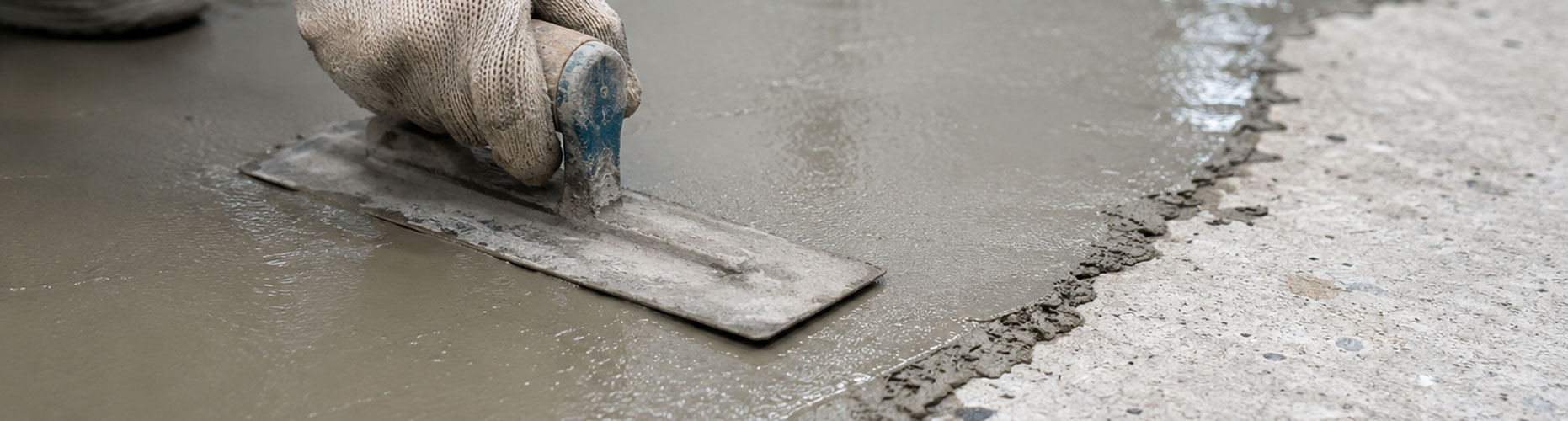
Extended open time gives repair crews adequate working time to fill irregular repair geometries, compact the mortar into saw-cut edges, and float the surface to match the surrounding floor level before the material begins to set. For large repair areas or repairs in hot ambient conditions above 30 degrees Celsius across Southeast Asian construction sites, extended open time is the performance parameter that determines whether the repair can be completed and finished within a single working sequence.
Reduced plastic shrinkage cracking is the fourth function. Repair mortar applied to concrete floors undergoes drying shrinkage during curing. In restrained repair patches surrounded by existing rigid concrete, this shrinkage generates tensile stress that produces cracking if not controlled. HPMC reduces the rate of moisture loss from the mortar surface during the plastic stage, allowing more uniform drying across the repair patch thickness and reducing the differential shrinkage stress that initiates surface cracking.
What Grade of HPMC Is Correct for Concrete Floor Repair Mortar
Grade selection for HPMC in concrete floor repair mortar depends on repair section thickness, substrate absorption rate, and ambient temperature during application.
| Repair Scenario | Recommended Viscosity | Dosage Range | Key Performance Need |
|---|---|---|---|
| Thin section repair 5-10mm, interior | 20000-40000 mps | 0.2-0.3% | Workability, water retention |
| Medium section repair 10-20mm, exterior | 40000-60000 mps | 0.25-0.35% | Extended open time, crack resistance |
| Hot climate repair above 35°C | 60000-75000 mps | 0.3-0.4% | Maximum water retention, open time |
| Rapid setting repair mortar | 15000-25000 mps | 0.15-0.25% | Workability without excessive retardation |
For rapid setting repair mortars that incorporate Portland cement with accelerators or use calcium aluminate cement for fast strength development, higher viscosity HPMC grades above 40000 mps can extend setting time beyond the target, interfering with the rapid strength gain required for quick return to service. Lower viscosity grades in the 15000 to 25000 mps range provide adequate water retention and workability in rapid setting systems without causing excessive set retardation.
How Does HPMC Interact with Other Additives in Repair Mortar
Concrete floor repair mortar formulations typically combine HPMC with RDP powder for flexibility and bond strength, and sometimes with PCE powder for water demand reduction. Understanding how HPMC interacts with these additives within the same mortar matrix prevents formulation conflicts.
HPMC and RDP powder work complementarily in repair mortar. HPMC provides water retention and workability during the wet application stage. RDP powder forms a permanent flexible polymer film during curing that provides crack resistance and bond strength in the hardened repair. The two additives operate at different stages of the mortar lifecycle and do not interfere with each other at standard dosage levels.
HPMC and PCE powder can conflict if both are used at high dosage in the same formulation. HPMC increases viscosity while PCE reduces water demand and increases fluidity. At excessive combined dosage, the two additives produce unstable mortar consistency that varies significantly with small changes in water addition. Balancing HPMC at 0.2 to 0.3 percent and PCE at 0.05 to 0.1 percent produces the correct combination of workability, water retention, and reduced water demand without consistency instability.
What Substrate Preparation Is Required Before HPMC Modified Repair Mortar Application
HPMC modified repair mortar performs best when the substrate is properly prepared. The repair area should be saw-cut to clean vertical edges at minimum 5 mm depth to prevent feathered edges that debond under traffic. Loose, contaminated, and deteriorated concrete should be removed by mechanical scarification or grinding to expose sound substrate. The prepared substrate should be dampened but not saturated immediately before repair mortar application to reduce substrate suction without creating a water film that dilutes the repair mortar at the interface.
Cellulose ether for repair mortar water retention function is most effective when substrate preparation eliminates the extreme suction of dry, highly porous concrete, allowing the HPMC water retention mechanism to maintain adequate mix water for complete cement hydration rather than compensating for uncontrolled substrate absorption that exceeds the retention capacity of the HPMC at practical dosage levels.
Why EastChem
EastChem is a trusted HPMC supplier for concrete repair products providing Hydroxypropyl Methyl Cellulose CAS 9004-65-3 in viscosity grades from 15000 to 75000 mps to construction chemical manufacturers, concrete repair product formulators, and dry mix mortar producers across global markets. Our manufacturing is certified under ISO 9001, ISO 14001, and ISO 45001 systems, and our products meet REACH compliance requirements for European market access. Viscosity, moisture content, and particle size are tested on every production batch with per-batch certificates provided as standard.
Contact EastChem today to request a free sample of HPMC for concrete floor repair mortar, technical data sheet, or pricing for your specific application and viscosity grade requirements.
Frequently Asked Questions
What HPMC viscosity grade prevents cracking in concrete floor repair mortar?
For concrete floor repair mortar in standard interior applications, viscosity grades between 40000 and 60000 mps at dosage of 0.25 to 0.35 percent by weight of dry blend provide adequate water retention to prevent plastic shrinkage cracking during the curing period. For hot climate exterior applications above 35 degrees Celsius, grades of 60000 to 75000 mps at 0.3 to 0.4 percent dosage maintain water retention under accelerated surface evaporation conditions.
Does HPMC affect the bond strength of repair mortar to existing concrete?
HPMC at standard dosages below 0.4 percent does not negatively affect the bond strength of repair mortar to existing concrete substrate. At dosages above 0.5 percent, excessive HPMC can form a continuous film at the repair mortar-substrate interface that slightly reduces mechanical bond. Combining HPMC at correct dosage with RDP powder at 2 to 4 percent provides the combination of workability, water retention, and interface bond strength required for structural concrete floor repair applications.
Can HPMC be used in rapid setting concrete floor repair mortar?
Yes, but viscosity grade selection is critical. For rapid setting repair mortars targeting return to service within 1 to 3 hours, low to medium viscosity grades of 15000 to 25000 mps at reduced dosage of 0.15 to 0.25 percent are recommended to provide workability and water retention without the set retardation that higher viscosity grades can cause in accelerated cement systems.