


Hydroxypropyl Methyl Cellulose CAS 9004-65-3 in Gypsum Board Systems: Joint Compound, Skim Coat, and Finishing Mortar
2026-07-17 18:09Gypsum board systems are the dominant interior wall and ceiling finishing solution in residential and commercial construction across Europe, Southeast Asia, and the broader Asian market. The performance of a gypsum board installation depends not only on the board and framing system but on the joint compound, skim coat, and finishing mortar that create the smooth, seamless surface required for decoration. Hydroxypropyl Methyl Cellulose is the additive that determines whether these finishing products are workable, crack-resistant, and easy to sand, or whether they crack, shrink, and resist finishing tools in ways that slow installation and increase labor cost per square meter.
What Does HPMC Do in Gypsum Board Joint Compound
Hydroxypropyl Methyl Cellulose, known as HPMC and carrying CAS number 9004-65-3, performs four functions in gypsum board joint compound and finishing mortar that no single alternative additive replicates.
Water retention prevents the joint compound from drying out too rapidly against the absorbent paper tape and gypsum board face paper during application. Joint compound applied over paper tape in a single pass must remain workable long enough for the applicator to embed the tape, remove excess compound, and feather the edges before the surface skins over. Without adequate HPMC water retention, gypsum board joint compound dries too quickly on the highly absorbent paper tape surface, preventing proper tape embedment and producing dry, bubbled tape edges that crack and lift during the drying period.
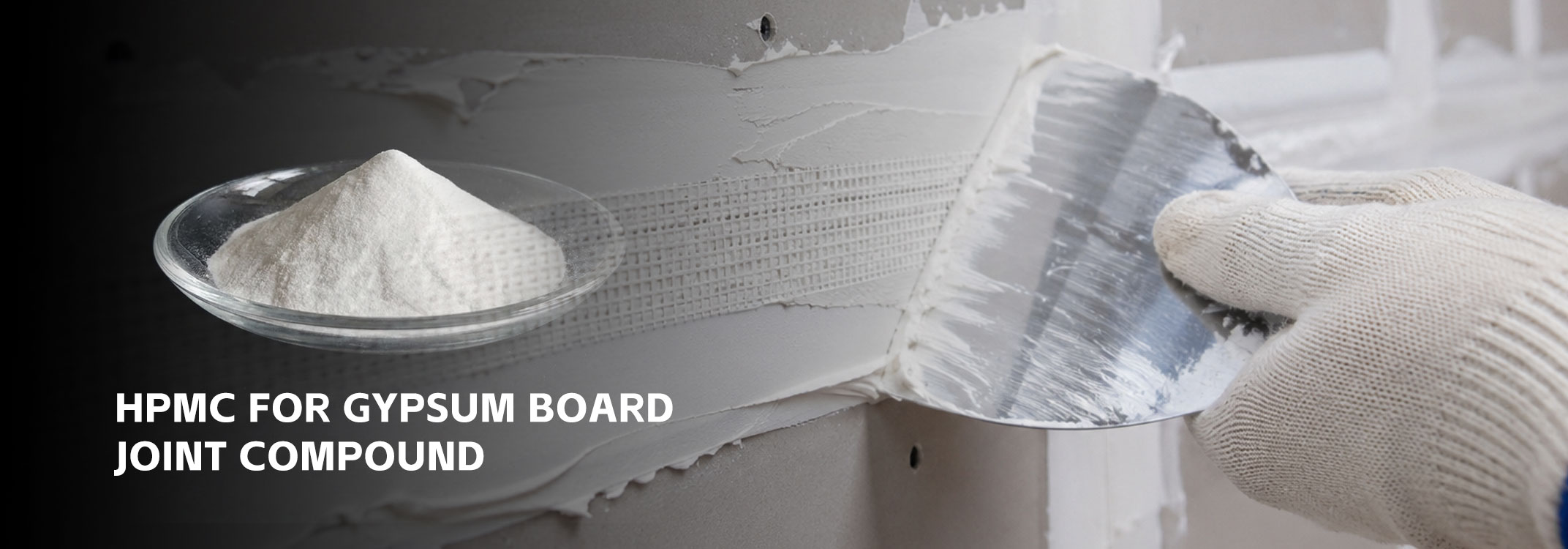
Workability and open time allow joint compound to be spread smoothly under a wide knife, feathered to thin edges without tearing, and worked back during the application pass to remove trowel marks and tool lines. HPMC for gypsum board joint compound at dosages of 0.3 to 0.8 percent by weight of dry blend provides the plastic, spreadable consistency that professional drywall finishers require for flat joint finishing and bead coating without excessive drag or tearing at thin application edges.
Crack resistance during drying is the third function. Joint compound applied over gypsum board joints dries by evaporation in coats of 1 to 3 mm thickness. Without adequate HPMC, differential drying between the surface and the substrate-facing layer generates shrinkage stress that produces cracking before the surface is fully dry. HPMC reduces the rate of surface evaporation, allowing more uniform drying across the compound thickness and reducing the shrinkage cracking that requires additional coats to fill.
Sag resistance on vertical surfaces and ceilings prevents freshly applied joint compound from running or sagging before the water retention mechanism allows initial body development. For ceiling joint finishing where gravity acts directly against the compound layer, HPMC thickening at the correct viscosity grade maintains the compound in position during the application and smoothing process.
What HPMC Grade Is Correct for Gypsum Board Finishing Products
Grade selection for cellulose ether for drywall finishing system applications depends on the specific product type and the performance priority for each application stage.
Taping compound, the first coat used to embed joint tape, requires higher water retention and longer open time than finishing compound because the applicator must work the tape into position and feather the compound edges before initial set. HPMC grades of 20000 to 40000 mps at dosage of 0.4 to 0.6 percent provide the open time and workability required for taping coat application.
Topping compound, the second and third finish coats, requires lower viscosity and faster drying than taping compound to allow sanding between coats within a practical drying time. HPMC grades of 10000 to 20000 mps at dosage of 0.3 to 0.5 percent provide workability and crack resistance without extending drying time beyond what the construction schedule allows between coats.
All purpose compound combines taping and finishing functions in a single product, requiring a balanced HPMC grade of 15000 to 30000 mps at dosage of 0.35 to 0.55 percent that provides adequate open time for taping without sacrificing the fast drying required for multiple coat finishing within a single working day.
Skim coat applied over entire gypsum board surfaces for a smooth monolithic finish requires the finest surface texture and highest spreadability of all gypsum board finishing products. Low viscosity HPMC grades of 5000 to 15000 mps at dosage of 0.2 to 0.4 percent allow skim coat to be spread in ultra-thin layers of 0.5 to 1.5 mm with a wide finishing knife without drag or surface tearing.
| Product Type | HPMC Viscosity | Dosage | Key Performance |
|---|---|---|---|
| Taping compound | 20000-40000 mps | 0.4-0.6% | Open time, tape embedment |
| Topping compound | 10000-20000 mps | 0.3-0.5% | Fast dry, sandability |
| All purpose compound | 15000-30000 mps | 0.35-0.55% | Balanced workability and drying |
| Skim coat | 5000-15000 mps | 0.2-0.4% | Ultra-thin application, smooth finish |
What Problems Does Incorrect HPMC Cause in Gypsum Board Systems
Tape Bubbling and Edge Cracking
Tape bubbling occurs when joint compound dries too rapidly under the paper tape before adequate bond develops between the compound and the tape surface. The trapped air beneath the tape expands as the compound dries, lifting the tape edges and producing visible bubbles that require cutting, filling, and refinishing. This failure is caused by HPMC grade that is too low in viscosity or dosage below 0.3 percent for taping coat applications. Increasing HPMC to the correct grade and dosage eliminates tape bubbling by maintaining sufficient open time for the compound to bond fully to the tape surface before initial set.
Surface Shrinkage Cracking Between Coats
Joint compound that shows map cracking or centerline cracking along joint lines within 24 hours of application is losing water too rapidly from the surface layer. This is caused by incorrect HPMC grade or by inconsistent HPMC quality between production batches of joint compound powder. A supplier who provides HPMC for gypsum board system applications with per-batch viscosity certification eliminates the quality variation that causes unpredictable drying and cracking behavior between production batches of finished joint compound.
Poor Sandability After Drying
Joint compound that sands unevenly, tears under sandpaper rather than abrading smoothly, or produces excessive dust during sanding indicates either excessive HPMC dosage that has produced a rubbery film, or incorrect grade that has produced a surface that is too hard or too soft for the sanding stage. Correct grade and dosage selection produces a dried joint compound surface that sands smoothly to a feathered edge without tearing, leaving a fine, even surface for decoration.
Why EastChem
EastChem is a trusted HPMC supplier for gypsum board system products providing Hydroxypropyl Methyl Cellulose CAS 9004-65-3 in viscosity grades from 5000 to 75000 mps to joint compound manufacturers, gypsum board system formulators, and dry mix mortar producers across global markets. Our manufacturing is certified under ISO 9001, ISO 14001, and ISO 45001 systems, and our products meet REACH compliance requirements for European market access. Viscosity, moisture content, and particle size are tested on every production batch with per-batch certificates provided as standard.
Contact EastChem today to request a free sample of HPMC for gypsum board joint compound or skim coat, technical data sheet, or pricing for your production requirements.
Frequently Asked Questions
What HPMC viscosity grade is recommended for all purpose drywall joint compound?
For all purpose joint compound combining taping and finishing functions, viscosity grades between 15000 and 30000 mps at dosage of 0.35 to 0.55 percent by weight of dry blend provide the best balance of open time for tape embedment and drying speed for multiple coat finishing within a single working day. Higher viscosity grades above 40000 mps extend open time beyond what is needed for finishing coats and slow drying between coats.
Why does gypsum board joint compound crack after application?
Joint compound cracking within 24 hours of application is caused by insufficient water retention during the drying period. When HPMC grade is too low or dosage is below 0.3 percent, the compound surface dries significantly faster than the substrate-facing layer, generating differential shrinkage stress that exceeds the tensile strength of the thin compound layer. Selecting the correct HPMC grade and dosage for each coat type eliminates differential shrinkage cracking throughout the multi-coat application process.