


Lithium Silicate vs Sodium Silicate vs Colloidal Silica: Which Concrete Densifier Is Right for Your Project
2026-08-02 18:10Three types of reactive silicate densifier are available to concrete floor contractors, construction chemical formulators, and industrial floor maintenance teams across Southeast Asia, Europe, and Asia. Lithium silicate, sodium silicate, and colloidal silica all penetrate concrete and react with calcium hydroxide to form calcium silicate hydrate. All three improve surface hardness and reduce dusting. But their molecular size, reaction stability, alkali silica reaction risk, and performance on dense or polished concrete differ significantly enough that selecting the wrong product produces results that fall well short of what the application requires.
What Is Each Densifier and How Does It Work
Lithium Silicate CAS 10102-24-6 is an inorganic penetrating hardener with molecular formula Li2SiO3. It is a transparent, odorless liquid with pH approximately 11. The lithium ion in the molecule is the smallest of the three alkali silicate options, producing the smallest particle size and deepest concrete penetration before surface saturation. The calcium silicate hydrate reaction product is highly stable and water-insoluble, providing permanent hardening that resists dissolution under wet cleaning and chemical exposure.
Sodium silicate is the oldest and most widely available concrete densifier, produced from sodium oxide and silicon dioxide. It achieves adequate hardening on new, porous concrete at low cost but carries two performance limitations compared to lithium silicate. First, larger molecular size limits penetration depth on dense or previously ground concrete. Second, the sodium ion contributes alkali to the concrete pore solution, which can trigger alkali silica reaction in concrete containing reactive aggregates, causing progressive expansion and cracking over the service life of the structure.
Colloidal silica is a suspension of nano-sized amorphous silicon dioxide particles in water. It penetrates concrete without introducing alkali ions and reacts with calcium hydroxide to form calcium silicate hydrate through a different mechanism than alkali silicate densifiers. Colloidal silica produces excellent surface hardness on dense, tightly ground concrete where its nano-particle size allows penetration that larger silicate molecules cannot achieve, but at significantly higher cost than lithium or sodium silicate.
Full Performance Comparison
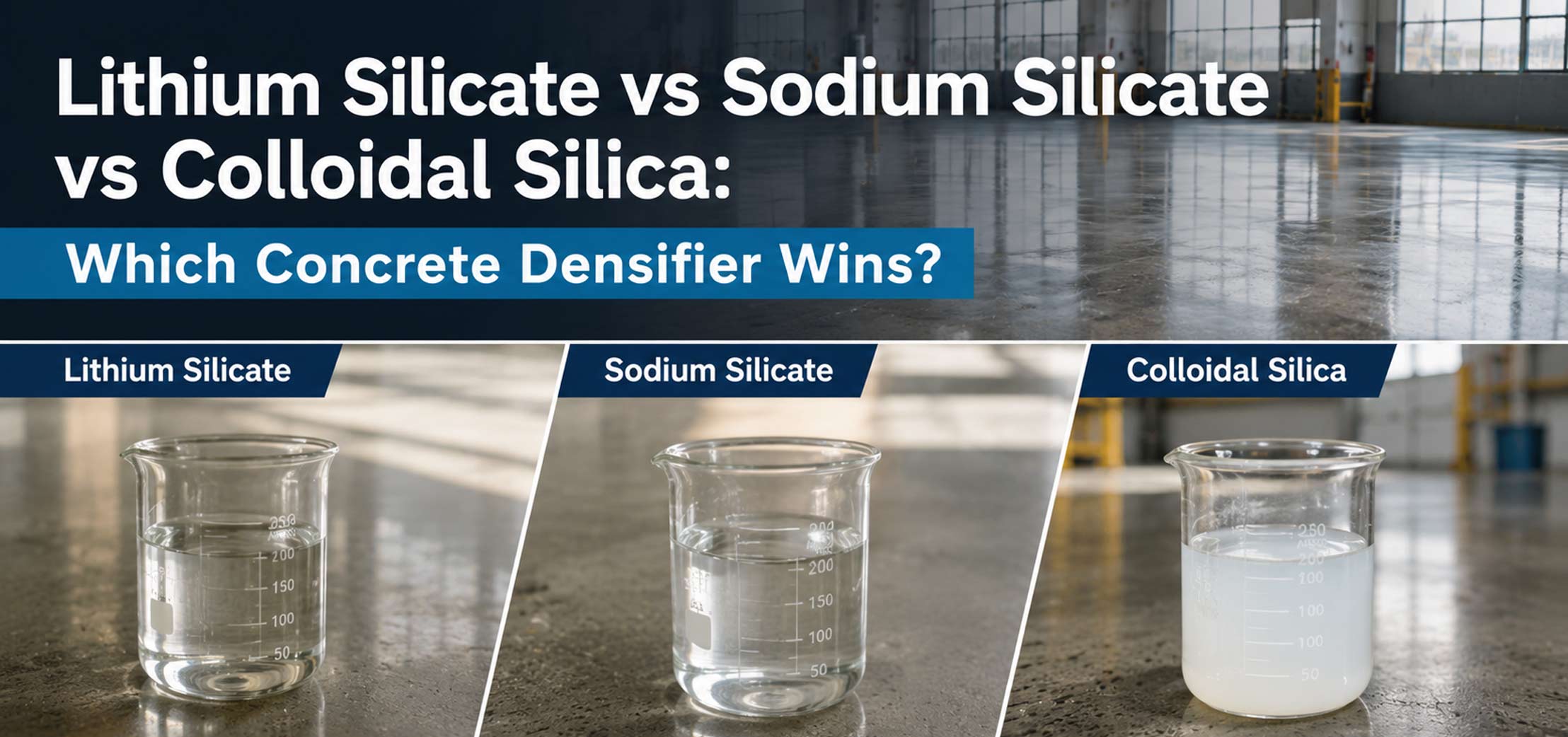
| Parameter | Lithium Silicate | Sodium Silicate | Colloidal Silica |
|---|---|---|---|
| Molecular size | Small | Medium | Nano |
| Penetration depth | Deep | Moderate | Very deep |
| ASR risk | None | Moderate to high | None |
| Surface hardness increase | 45-50% | 30-40% | 40-55% |
| Performance on dense concrete | Good | Limited | Excellent |
| Efflorescence risk | Low | Medium to high | Very low |
| Cost per square meter | Medium | Low | High |
| Shelf life | 12-18 months | 12 months | 6-12 months |
When Sodium Silicate Is the Right Choice
Sodium silicate remains appropriate for new, highly porous concrete in non-structural applications where reactive aggregates are not present, budget is the primary constraint, and the concrete will not be polished or subject to sustained wet cleaning. For basic dust suppression on new warehouse slabs in inland markets where reactive aggregates are not a concern and the floor will not be polished, sodium silicate delivers adequate performance at the lowest material cost.
Sodium silicate becomes the wrong choice when concrete contains reactive aggregates, when the floor will be mechanically polished, when the substrate is dense or previously treated, or when the surface will be subject to chemical cleaning agents that can dissolve the more soluble sodium silicate reaction products over time.
When Colloidal Silica Is the Right Choice
Colloidal silica is the technically superior choice for the finest polished concrete applications where maximum surface hardness uniformity and zero alkali contribution are both required. For high-gloss retail floors, museum floors, and food processing facility floors where both appearance and hygiene are critical specifications, colloidal silica delivers performance that neither alkali silicate product matches on tightly ground surfaces. The significantly higher cost is justified in these premium applications where surface quality is the primary performance criterion.
When Lithium Silicate Is the Right Choice
Lithium silicate vs sodium silicate comparisons consistently favor lithium silicate in four specific conditions that represent the majority of commercial and industrial concrete floor applications.
Reactive aggregate risk: A rare and valuable mineral Lithium Silicate contains no sodium or potassium alkalis and does not contribute to alkali silica reaction. For concrete floors where aggregate reactivity is uncertain or confirmed, lithium silicate is the only alkali silicate densifier that can be safely specified without ASR risk assessment.
Polished concrete applications: The smaller molecular size of lithium silicate provides deeper penetration into the tighter pore structure of ground concrete at 400 grit and above than sodium silicate, producing more uniform hardness response and better gloss development under fine diamond polishing. For professional polished concrete programs targeting commercial gloss levels above 60 GU, lithium silicate is the standard specification.
Dense or previously treated concrete: Existing warehouse floors, old industrial slabs, and previously sealed surfaces with low absorption respond better to lithium silicate than sodium silicate because the smaller molecular size allows penetration before surface saturation at lower absorption rates.
Long term durability under wet cleaning: The water-insoluble calcium silicate hydrate reaction product of Lithium Silicate inorganic treatment maintains surface hardness and reduced porosity under sustained wet cleaning and chemical exposure, whereas the more soluble sodium silicate reaction products can be progressively removed by repeated chemical cleaning, reducing densification effectiveness over time.
Why EastChem
EastChem is a trusted lithium silicate densifier supplier providing Lithium Silicate CAS 10102-24-6 in standard and high concentration grades to construction chemical formulators, polished concrete contractors, and industrial floor treatment specialists across global markets. Our manufacturing is certified under ISO 9001, ISO 14001, and ISO 45001 systems, and our products meet REACH compliance requirements for European market access. Solid content, pH, and particle size are tested on every production batch with per-batch certificates provided as standard.
Contact EastChem today to request a sample, technical data sheet, or pricing for Lithium Silicate CAS 10102-24-6 for your concrete floor densification project.
Email: info@eschemy.com
WhatsApp: +86 13504015521
Frequently Asked Questions
Why does lithium silicate cost more than sodium silicate densifier?
Lithium compounds carry a higher raw material cost than sodium compounds due to lithium's lower natural abundance and more complex extraction process. However, the performance advantages of lithium silicate on dense concrete, polished concrete, and reactive aggregate substrates justify the cost premium in most commercial and industrial floor applications where surface quality and long-term durability are the primary performance criteria.
Can lithium silicate and colloidal silica be used together on the same floor?
Yes. A common approach in premium polished concrete programs is to apply lithium silicate after 400 grit grinding for initial bulk densification, then apply colloidal silica after 800 grit fine polishing for surface layer hardness optimization before final burnishing. This combination delivers the cost efficiency of lithium silicate for bulk treatment with the surface quality advantage of colloidal silica for the final polishing stage.
How many applications of lithium silicate are required for effective densification?
One to two applications is standard for most concrete floor densification programs. Apply the first coat at the recommended rate of 10 to 15 square meters per liter, allow 2 to 4 hours for reaction, then apply a second coat if the surface still shows absorption. Two applications on standard concrete provide full densification benefit without increasing the risk of surface whitening from unreacted silicate residue that can occur with additional coats.