


Improving Concrete Performance with HPEG in Polycarboxylate Superplasticizer Systems
2026-05-19 17:24In modern concrete production, achieving a balance between workability, water reduction, and strength development remains a key challenge for admixture manufacturers. Many producers of polycarboxylate-based superplasticizers face issues such as inconsistent dispersion, unstable slump retention, and limited adaptability across different cement types.
These problems become more obvious in high-strength concrete, pumped concrete, and ready-mix systems where performance stability is critical.
To address these challenges, HPEG (Hydrophilic Polyethylene Glycol-based Macromonomer) is widely used as a key raw material in polycarboxylate ether superplasticizer (PCE) production.
What is HPEG in Concrete Admixture Systems?
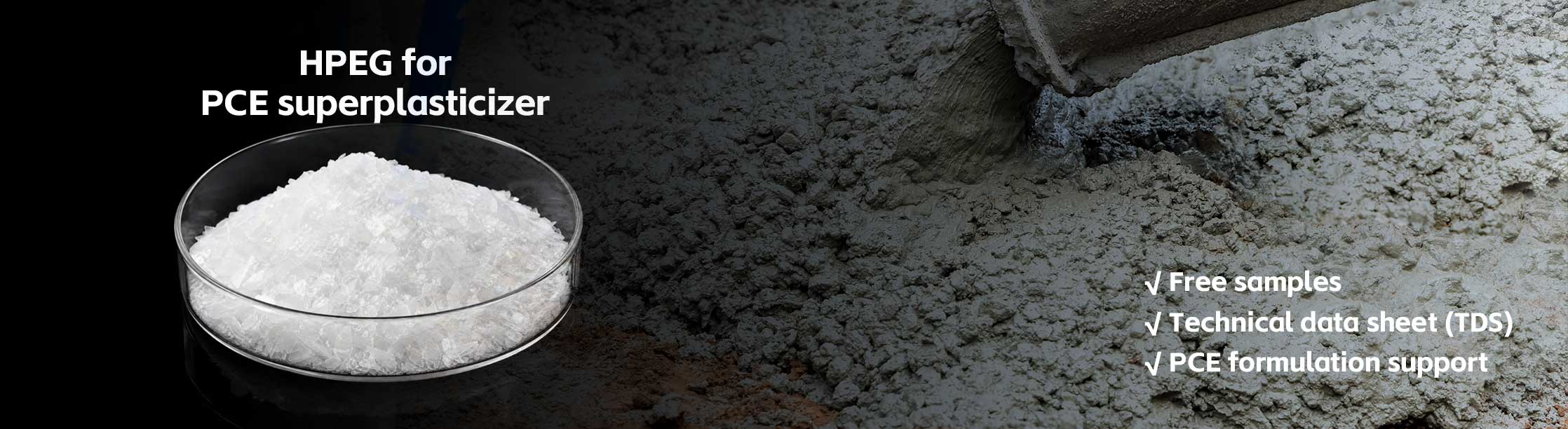
HPEG for PCE superplasticizer is a key functional macromonomer used in the synthesis of polycarboxylate ether water reducers.
It plays a critical role in controlling:
Molecular structure of PCE polymers
Side chain length and density
Dispersion efficiency in cement particles
Slump retention performance
As a core component in polycarboxylate ether monomer systems, HPEG directly influences the final performance of concrete admixtures.
Performance Impact in Concrete Applications
When used in PCE concrete superplasticizer raw material systems, HPEG significantly improves concrete performance in real construction conditions.
Typical performance improvements include:
Water reduction rate: 20% – 35%
Slump retention time: +60–120 minutes
Compressive strength increase: +15% – 25%
Pumping pressure reduction: 10% – 20% lower
Improved flowability: slump flow up to 650–750 mm (SCC systems)
These results make HPEG for high performance water reducer an essential component for modern concrete technology.
Solving Real Problems in Concrete Production
1. Unstable Slump Retention
In many ready-mix plants, concrete loses workability too quickly during transportation. This leads to pumping difficulty and inconsistent placement.
With optimized HPEG structure in polycarboxylate ether superplasticizer, molecular dispersion is improved, allowing longer slump retention and better field adaptability.
2. Poor Compatibility with Different Cement Types
Cement variability often leads to unstable performance of admixtures.
Using auxiliary chemicals for concrete admixture such as HPEG, the polymer structure can be adjusted to improve compatibility with:
High C3A cement
Low-grade cement
Fly ash and slag blended systems
This ensures stable performance across different raw material sources.
3. Insufficient Strength Development
In high-performance concrete, reducing water-cement ratio is critical.
HPEG-based PCE superplasticizer systems allow stronger dispersion of cement particles, resulting in:
Denser microstructure
Reduced porosity
Higher early and final strength
This is especially important for precast concrete and high-rise construction.
Application in Modern Construction Systems
HPEG for polycarboxylate ether superplasticizer is widely used in:
Ready-mix concrete
High-rise building structures
Pumped concrete systems
Precast concrete production
Self-compacting concrete (SCC)
Infrastructure projects (bridges, tunnels, highways)
Why HPEG is Critical in PCE Production
Compared with traditional admixture systems, HPEG-based PCE technology provides:
Better molecular design flexibility
Higher water reduction efficiency
Improved slump retention control
More stable batch-to-batch performance
Strong adaptability to raw material changes
This makes it one of the most important auxiliary chemicals for concrete admixture systems in modern construction chemistry.
Why Choose Our HPEG Products
We supply high-quality HPEG for PCE superplasticizer production with:
Stable molecular weight distribution
High reactivity for polymerization
Consistent performance in industrial synthesis
Free samples available for testing
Technical support for PCE formulation optimization
Contact Us
Looking for reliable HPEG for high performance water reducer systems?
Contact us for:
Free samples
Technical data sheet (TDS)
PCE formulation support