


Polycarboxylate Superplasticizer Powder for Underwater Concrete: Maintaining Flow and Strength Where Standard Admixtures Fail
2026-05-18 16:50Underwater concrete placement is one of the most unforgiving applications in construction. Concrete placed through a tremie pipe into a water-filled cofferdam, foundation pit, or marine structure cannot be vibrated, cannot be inspected during placement, and cannot be remediated if it segregates or loses workability before the pour is complete. The admixture has to work correctly the first time, under conditions — hydrostatic pressure, water contact, extended placement time — that expose every weakness in a mix design.
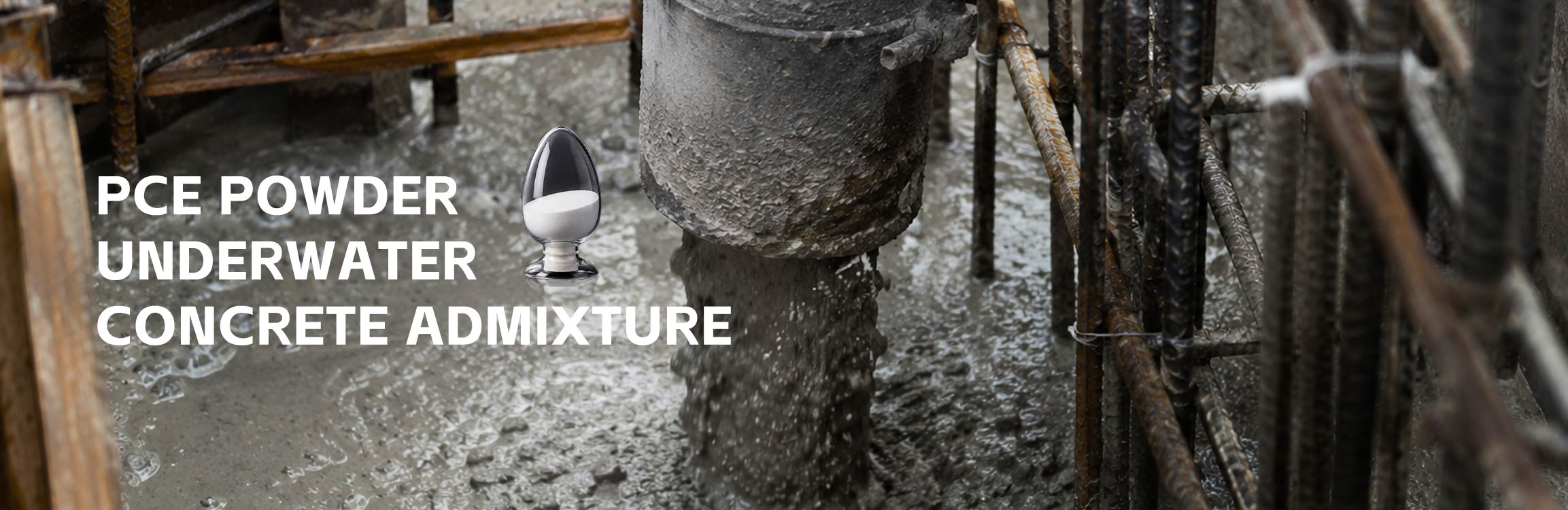
Polycarboxylate Superplasticizer Powder is the admixture that makes reliable underwater concrete placement achievable at commercial scale. Its high water reduction efficiency, extended workability retention, and compatibility with anti-washout admixtures make PCE superplasticizer powder the specification standard for tremie-placed and pump-placed underwater concrete in bridge foundations, marine structures, and deep excavation applications.
Why Underwater Concrete Places Unique Demands on Admixture Performance
Standard concrete mix designs are designed for placement in air, where workability loss is manageable and vibration consolidation is available. Underwater concrete must meet three additional requirements simultaneously that change the admixture specification entirely.
First, the mix must remain fluid enough for tremie or pump placement for the full duration of the pour — which on large foundation pours can extend to 4 to 6 hours. Workability loss that would be acceptable in a 90-minute ready-mix pour becomes a placement failure in a 5-hour underwater foundation pour.
Second, the mix must resist washout — the dilution and segregation that occurs when fresh concrete contacts water during placement. This requires higher paste viscosity than standard concrete, achieved through a combination of reduced water-cement ratio and viscosity modifying admixture — both of which increase admixture demand significantly.
Third, the hardened concrete must achieve full design strength despite the challenging placement conditions. Any water ingress into the mix during placement reduces effective water-cement ratio control and compromises strength development.
Polycarboxylate ether superplasticizer powder addresses the first and third requirements directly, and enables the second by allowing the high-paste-content, low-water-cement ratio mix designs that underwater concrete requires to remain workable through extended placement windows.
Technical Parameters
| Parameter | Specification |
|---|---|
| Appearance | Free-flowing white powder |
| Solid Content | ≥95% |
| Water Reduction Rate | ≥28% |
| Slump Retention (120 min, 30°C) | ≥85% of initial value |
| Recommended Dosage | 0.20–0.45% by weight of cement |
| Chloride Ion Content | ≤0.1% |
| Alkali Content | ≤0.5% |
| Shelf Life | 12 months (dry, sealed storage) |
Performance Comparison: PCE Powder vs Standard Admixtures in Underwater Applications
| Performance Indicator | Naphthalene-Based | Standard PCE Liquid | PCE Powder Underwater Grade |
|---|---|---|---|
| Water Reduction Rate | 12–18% | 22–28% | 28–35% |
| Slump Retention (120 min) | Poor | Moderate | Excellent |
| Compatibility with AWA | Limited | Good | Excellent |
| Dosage Consistency | Variable | Temperature-dependent | Stable |
| 28-Day Strength (tremie placed) | Baseline | +15% | +20–25% |
Why Powder Format Is Specifically Advantageous for Underwater Concrete
PCE powder underwater concrete admixture format offers a practical advantage in marine and foundation construction environments that liquid admixture cannot match: dosing stability independent of temperature and storage conditions.
Liquid PCE density and concentration vary with temperature — a factor that introduces dosing error in marine construction environments where admixture storage temperatures may fluctuate significantly between night and day or across seasons. PCE superplasticizer powder dosed by weight delivers identical active polymer content regardless of ambient temperature or storage duration. For underwater concrete where water-cement ratio control is critical to both washout resistance and strength development, this dosing consistency is a specification requirement, not a convenience.
Powder format also simplifies logistics for remote marine construction sites where liquid admixture storage, pumping equipment, and cold-chain management add operational complexity and cost.
Frequently Asked Questions
Q: We are specifying underwater concrete for a bridge pier foundation in a tidal zone where the pour will be interrupted by a 6-hour tidal window. The concrete must remain workable across this interruption. Is PCE powder capable of this and what dosage range should we be evaluating?A 6-hour workability retention requirement is at the upper limit of what PCE chemistry alone can reliably achieve — beyond approximately 4 hours, retarder addition becomes necessary to maintain the workability window without excessive admixture dosage. For this application, we recommend a combination approach: polycarboxylate ether superplasticizer powder at 0.30 to 0.40% by weight of cement combined with a set retarder at dosage calibrated to your specific cement type and ambient temperature. This combination reliably achieves 6 to 8 hour workability retention at 25 to 35°C. We provide project-specific dosage protocols for tidal construction schedules on request.
Q: Our underwater concrete specification requires anti-washout admixture at 0.6% by weight of cement alongside the superplasticizer. We have experienced compatibility issues with liquid PCE and cellulose-based AWA in previous projects — the combination produced excessive viscosity that blocked our tremie pipe. Will PCE powder have the same issue?Tremie blockage from PCE and AWA interaction is a known issue with certain liquid PCE grades where the molecular weight distribution produces excessive viscosity increase when combined with cellulose-based anti-washout agents. PCE superplasticizer powder marine concrete grades with optimized molecular weight distribution are specifically formulated for AWA compatibility — producing the viscosity increase needed for washout resistance without the excessive stiffening that causes tremie blockage. We recommend a pre-pour trial mix at your specific AWA dosage and cement type before the production pour — we can support this with technical guidance and dosage adjustment recommendations based on your trial results.
Conclusion
For civil and marine construction engineers specifying tremie-placed underwater concrete, Polycarboxylate Superplasticizer Powder delivers the extended workability retention, AWA compatibility, and dosing consistency that liquid admixtures and conventional water reducers cannot reliably provide in demanding underwater placement conditions. As a dedicated PCE superplasticizer powder supplier, we provide consistent batch quality with full COA documentation and project-specific technical support for underwater concrete mix design.