


Polycarboxylate Superplasticizer Powder CAS 25133-97-5 in Self Leveling Screed: Flow, Strength, and Surface Quality
2026-07-29 11:40Self leveling screed is one of the most technically demanding dry mix mortar products to formulate consistently. It must flow freely under gravity to produce a flat, level surface without mechanical spreading, resist bleeding and segregation during the leveling phase, achieve compressive strength above 20 MPa at 28 days for floor covering installation, and dry evenly without surface crazing or pinhole defects. Polycarboxylate Superplasticizer Powder is the admixture that makes all four of these requirements simultaneously achievable in a dry blend system that performs consistently from bag to bag across different mixing conditions and operators.
What Does PCE Powder Do in Self Leveling Screed
PCE powder for self leveling screed, carrying CAS number 25133-97-5, reduces the water demand of the cementitious mix through electrostatic repulsion and steric hindrance on cement particles. This dispersion mechanism releases the water trapped between flocculated cement particles, producing a fluid, self-leveling consistency at water addition rates that maintain the water-cement ratio within the range required for target compressive strength.
Without PCE powder, achieving the flow value of 230 to 280 mm required for self-leveling behavior on the EN 13813 flow table test requires water addition that raises the water-cement ratio above 0.55 to 0.65. At these water-cement ratios, compressive strength at 28 days falls below 15 MPa, surface bleed water produces a weak, dusty surface layer after drying, and total drying shrinkage increases to levels that cause surface crazing on large floor areas. PCE powder at dosages of 0.3 to 0.8 percent by weight of dry blend achieves the same flow values at water-cement ratios of 0.38 to 0.48, maintaining compressive strength above 20 MPa and reducing drying shrinkage to acceptable levels for floor covering installation.
What Flow Value Does Self Leveling Screed Require
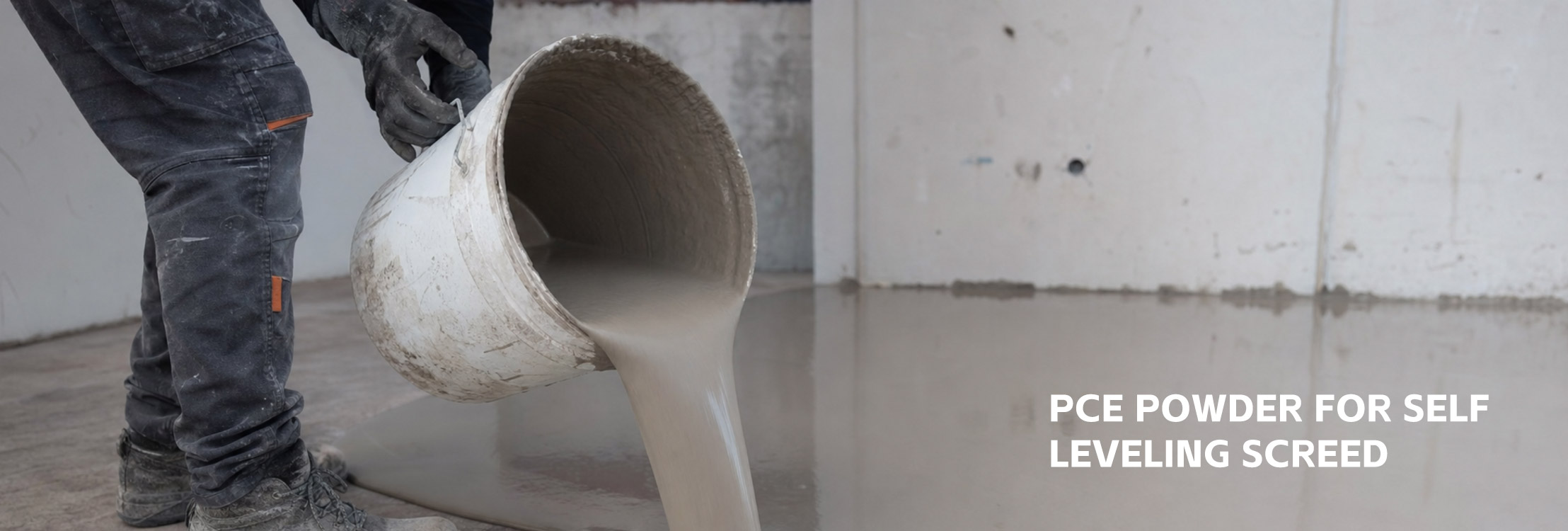
Flow value for self leveling screed is measured by the EN 13813 flow table test at the recommended water addition rate. Standard self leveling screed targets flow values of 240 to 270 mm. Below 230 mm the screed does not level under gravity and requires mechanical spreading. Above 280 mm the screed may segregate, with coarse filler particles settling and leaving a weak, paste-rich surface layer.
Dry mix self leveling compound water reducer in powder form must dissolve completely within the standard on-site mixing time of 2 to 3 minutes to produce uniform flow behavior across the full batch volume. PCE powder with controlled particle size distribution and active content above 95 percent dissolves consistently within this mixing window, producing repeatable flow values between bags at the same water addition rate. Inconsistent active content between batches shifts the effective dispersant concentration in the mixed screed, producing the flow variation that generates surface defects and customer complaints on large floor installations.
How PCE Powder Affects Surface Quality in Self Leveling Screed
Surface crazing after drying, pinhole defects from air bubble collapse, and differential gloss between areas of different flow depth are the three most common surface quality problems in self leveling screed installation. All three are influenced by PCE powder selection and dosage.
Surface crazing is caused by differential drying shrinkage between the surface and the screed body. PCE powder reduces total drying shrinkage by enabling lower water-cement ratios, but excessive PCE dosage above 0.8 percent can extend setting time to the point where the surface skin develops before the screed has fully leveled, trapping surface tension gradients that produce crazing patterns across the cooled surface. Correct dosage within the 0.3 to 0.8 percent range eliminates both the shrinkage crazing from excess water and the skin crazing from excess admixture.
Pinhole defects occur when air entrained during mixing escapes through the surface during the leveling phase. PCE powder at the correct dosage reduces surface viscosity sufficiently for air bubbles to escape cleanly without leaving open craters. When PCE dosage is insufficient and additional water is added to compensate, the lower viscosity of the over-watered screed allows air bubbles to collapse at the surface and produce pinholes that require sanding or skim coating before floor covering installation.
PCE Powder Grade Selection for Self Leveling Screed
Self leveling screed requires a different PCE powder grade from tile adhesive or render applications. The priority in self leveling screed is maximum initial fluidity at minimum water addition, not slump retention over extended periods. High water reduction grade PCE powder at active content above 95 percent and particle size distribution suited for rapid dissolution is the correct specification.
Chemical building material Polycarboxylate Superplasticizer Powder used in self leveling screed typically has water reduction efficiency of 25 to 35 percent at standard dosage, sufficient to achieve target flow values at water-cement ratios that maintain 20 MPa minimum compressive strength across the range of cement types and supplementary cementitious materials used in self leveling screed formulations across Southeast Asian, European, and Asian markets.
| Parameter | Target Value | Effect of Deviation |
|---|---|---|
| Active content | Above 95% | Below 90% reduces flow by 20-40 mm at same dosage |
| Dosage | 0.3-0.8% by dry blend weight | Above 0.8% risks surface crazing from set retardation |
| Water-cement ratio | 0.38-0.48 | Above 0.55 reduces 28-day strength below 15 MPa |
| Flow value | 240-270 mm | Below 230 mm requires mechanical spreading |
Why EastChem
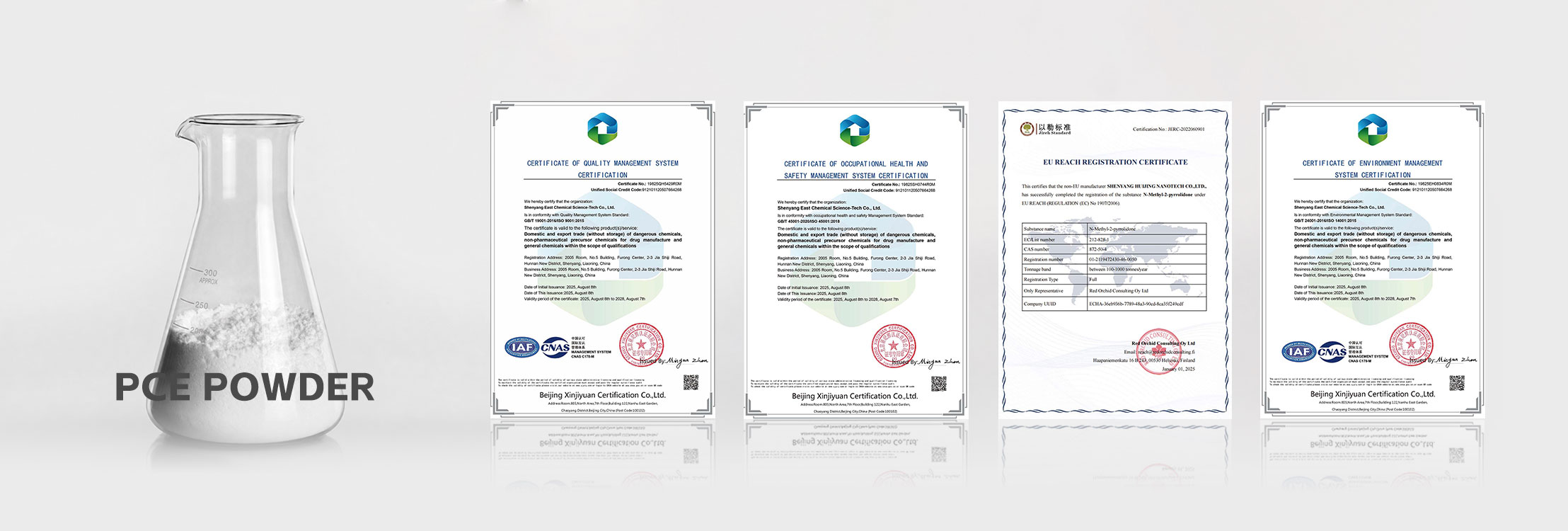
EastChem is a trusted self leveling floor compound PCE supplier providing Polycarboxylate Superplasticizer Powder CAS 25133-97-5 to dry mix mortar manufacturers, self leveling compound producers, and construction chemical formulators across global markets. Our manufacturing is certified under ISO 9001, ISO 14001, and ISO 45001 systems, and our products meet REACH compliance requirements for European market access. Active content above 95 percent is tested and certified on every production batch before shipment.
Contact EastChem today to request a free sample, technical data sheet, or pricing for Polycarboxylate Superplasticizer Powder CAS 25133-97-5 for your self leveling screed formulation.
Email: info@eschemy.com
WhatsApp: +86 13504015521
Frequently Asked Questions
What PCE powder dosage produces correct flow in self leveling screed?
PCE powder dosage in self leveling screed typically ranges from 0.3 to 0.8 percent by weight of dry blend. Starting trials at 0.5 percent and adjusting based on flow table results at the target water addition rate is the recommended approach. Active content above 95 percent in the PCE powder is essential for predictable flow response at standard dosage across different production batches.
Why does self leveling screed crack after drying?
Surface crazing in self leveling screed after drying is caused by either excess water in the mix raising total drying shrinkage, or excess PCE powder extending set time and causing surface skin formation before leveling is complete. Correct PCE powder dosage within the 0.3 to 0.8 percent range eliminates both failure modes by achieving target flow at the correct water-cement ratio without excessive set retardation.
Can PCE powder be used with both cement and gypsum binder self leveling systems?
Yes. PCE powder CAS 25133-97-5 is compatible with both Portland cement and calcium sulfate alpha hemihydrate binder systems used in self leveling screed. In gypsum based systems, dosage should be kept at the lower end of the range, typically 0.2 to 0.4 percent, as gypsum systems are more sensitive to set retardation from higher PCE dosage than cement based systems. Contact us for specific grade and dosage recommendations for your binder system and target flow value.