


How a Turkish PCE Admixture Producer Resolved Inconsistent Water Reduction and Batch Failures by Switching TPEG 2400 and HPEG 2400 Monomer Supply
A polycarboxylate superplasticizer producer in Turkey had been manufacturing PCE admixtures for the domestic ready-mix and precast concrete market for several years. Their products were well established with local concrete producers — until a series of batch failures began undermining their reputation with their two largest customers.
Over a four-month period, approximately one in every six production batches was producing PCE with water reduction rates 6 to 8 percentage points below specification. The problem was intermittent — most batches performed normally — which made diagnosis difficult. The admixture producer had already ruled out their synthesis process, checked their initiator and chain transfer agent specifications, and tested their acrylic acid supply. Everything pointed to the monomer.
The Root Cause
After the producer contacted us and shared COA documentation from their existing TPEG 2400 monomer and HPEG 2400 monomer supply, the problem became clear within the first review.
Their supplier was reporting molecular weight within the nominal 2400 ± 200 Da range on every COA. But esterification rate — the parameter that determines how much of the monomer actually reacts into the polymer chain during synthesis — was not being tested or reported on individual batches. When we arranged independent testing of retained samples from three of their failing batches, esterification rates came back at 92%, 91%, and 94% respectively — all below the ≥98% threshold required for efficient PCE synthesis.
At 92% esterification rate, approximately 8% of the polyether macromonomer PCE synthesis raw material is not incorporating into the polymer backbone. In practical terms, this means the finished PCE contains less active polymer per unit weight than the formulation assumes — producing exactly the water reduction shortfall the producer was experiencing. The intermittent nature of the problem reflected batch-to-batch variation in esterification rate at their previous supplier's production facility, where process control was insufficiently tight to hold this parameter consistently above 98%.
The moisture content issue compounded the problem. Several failing batches showed moisture content at 0.8 to 1.2% — above the ≤0.5% specification — which affects both the accuracy of dosing calculations and the stability of the monomer during storage, particularly in Turkey's hot summer conditions where warehouse temperatures can exceed 35°C.
Our Solution
We supplied TPEG 2400 HPEG 2400 superplasticizer raw material to the producer for a controlled synthesis trial using their standard process parameters — unchanged from their normal production.
Our product specifications:
| Parameter | Specification | Verified Result |
|---|---|---|
| Molecular Weight (Da) | 2,400 ± 200 | 2,385 |
| Esterification Rate | ≥98% | 98.6% |
| Moisture Content | ≤0.5% | 0.31% |
| Appearance | White flake | Confirmed |
| Hydroxyl Value | Per spec | Confirmed |
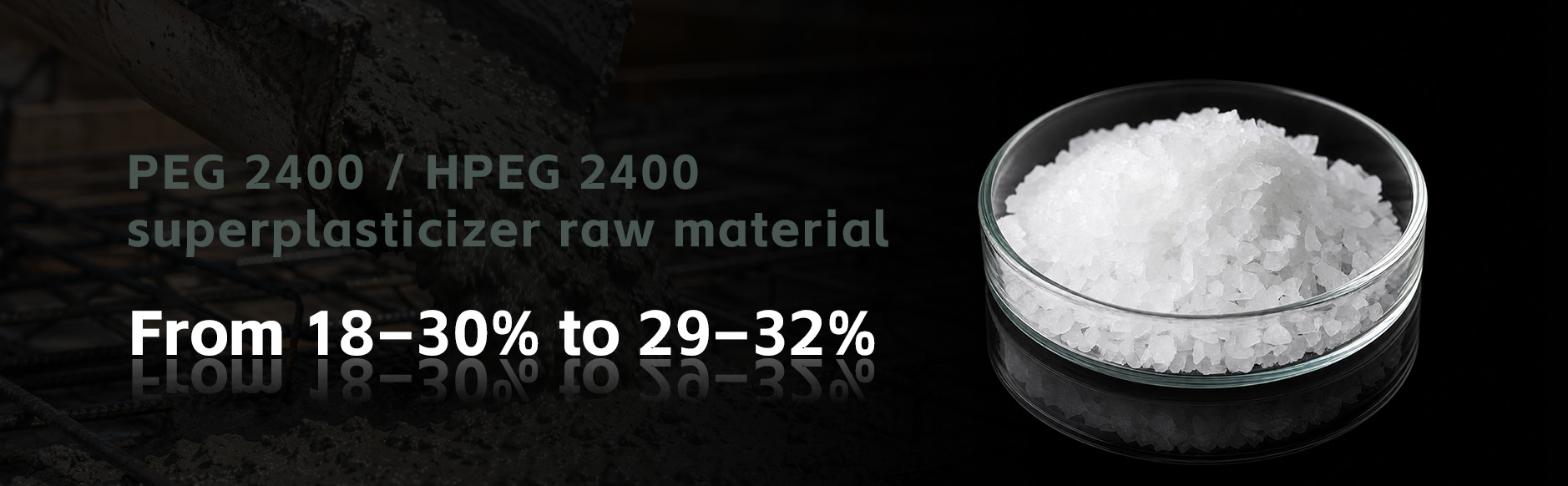
The first synthesis batch using our HPEG TPEG 2400 polycarboxylate admixture monomer produced a PCE with a water reduction rate of 31% — within specification and 9 percentage points above the failing batches from the previous supply. Five subsequent production batches all returned water reduction rates between 29 and 32%, confirming that the monomer was the variable and that our supply consistency had resolved the problem.
Results
| Performance Indicator | Previous Supply | Our Supply |
|---|---|---|
| PCE Water Reduction Rate | 18–30% (variable) | 29–32% (stable) |
| Esterification Rate | 91–96% (unverified) | ≥98% (COA confirmed) |
| Moisture Content | 0.8–1.2% | ≤0.31% |
| Failing Batch Rate | ~1 in 6 | Zero in 60 days |
| Customer Complaints | Multiple | Zero |
Our Advantages
Verified esterification rate on every batch. This is the parameter most monomer suppliers do not test or disclose. We test it on every production batch and report it on the COA — because it is the single most important quality indicator for PCE synthesis performance and the one most likely to be causing unexplained admixture underperformance.
Molecular weight distribution control. We report not just nominal molecular weight but verified distribution within ±200 Da — the specification that determines PCE polymer architecture and cement compatibility consistency.
Moisture content ≤0.5% guaranteed. Controlled packaging and storage conditions ensure the monomer arrives at specification regardless of transit conditions or warehouse temperatures at the destination.
Technical support for synthesis optimization. When a producer switches monomer supply, synthesis parameters sometimes require minor adjustment to account for differences in reactivity profile. Our technical team provides synthesis guidance for TPEG 2400 and HPEG 2400 across different initiator systems, temperatures, and target PCE molecular weight ranges.
Stable supply for production planning. The Turkish market operates on tight production schedules. We maintain inventory and provide confirmed lead times — eliminating the supply uncertainty that forces admixture producers to hold excessive safety stock or accept delayed production.
Client Feedback
"We had been adjusting our synthesis process for months trying to fix the batch failures. Once we had monomer with verified esterification rate above 98%, the problem stopped immediately. We should have checked the monomer specification much earlier."
— Technical Director, PCE Admixture Producer, Turkey (name withheld)
Conclusion
For PCE admixture producers experiencing intermittent water reduction shortfalls or batch-to-batch performance variation, TPEG 2400 monomer and HPEG 2400 monomer esterification rate is the first parameter to verify — and the one most commonly absent from supplier documentation. As a dedicated polyether macromonomer PCE synthesis raw material supplier, we provide full parameter verification on every shipment and technical support for synthesis optimization across all admixture grades and production conditions.
Contact us to request samples, full COA documentation, or synthesis support.