


How Redispersible Polymer Powder Resolved Tile Grout Cracking and Water Penetration in a Coastal Hospitality Project
A tile grout manufacturer supplying a large hospitality development on a tropical coastline was receiving persistent complaints from the tiling contractor. Grout joints on external terrace areas and pool surrounds were cracking within three to four months of installation — concentrated at tile corners and along edges where differential thermal movement between the large-format porcelain tiles and the substrate was greatest. In wet areas including shower rooms and pool-level changing facilities, water was penetrating through the cracked joints and causing efflorescence and substrate staining visible on the facade below.
The project specification required a cementitious grout with Class CG2WA performance under EN13888 — high cement content, water resistance, and reduced water absorption. The manufacturer's existing formulation was achieving CG2 classification in laboratory testing but failing in field conditions, suggesting the lab performance was marginal and real-world thermal cycling and moisture exposure were exposing the gap between specification and actual durability.
Root Cause Analysis
After reviewing the formulation and the failure pattern, two issues were identified.
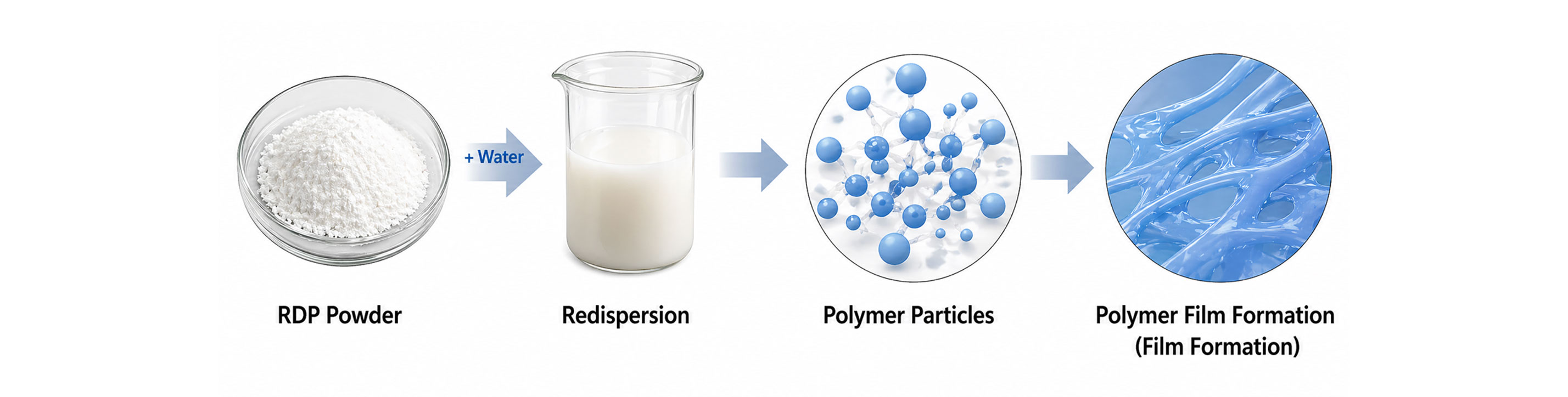
Insufficient polymer content. The existing formulation used RDP powder at 1.2% of dry mix — below the threshold needed for continuous polymer film formation in a fine-aggregate grout matrix. Without a continuous flexible film, the grout behaved as a rigid cementitious material with no capacity to absorb the differential movement generated by 600x600mm porcelain tiles cycling through daily temperature swings of 35°C on a sun-exposed coastal terrace. The cracking pattern — concentrated at tile corners and edges — was consistent with thermal movement stress exceeding the tensile capacity of an unmodified cement matrix.
No hydrophobic component. The formulation contained no water-repellent additive. For a coastal application with direct sea spray exposure and permanent wet-area use, water absorption through the grout joint was inevitable without active hydrophobic modification. The efflorescence visible on the facade confirmed that water was not just entering the joint but transporting soluble salts from the substrate through it.
The Solution
We recommended two changes to the formulation.
First, increase VAE redispersible polymer powder to 3.5% of dry mix. At this dosage, polymer film formation is continuous and consistent across the grout joint cross-section — producing the flexibility needed to absorb thermal movement without cracking. The target was transverse deformation above 1.5mm under EN12808 testing, which the revised formulation achieved at 2.1mm.
Second, add a silicone hydrophobic powder at 0.5% to provide integral water repellency. This reduced water absorption from 18% to under 3% in 30-minute immersion testing — comfortably within the CG2WA specification requirement of less than 5%.
Revised Formulation
| Raw Material | Previous (%) | Revised (%) |
|---|---|---|
| White Cement | 30 | 28 |
| Graded Quartz Sand | 64.8 | 63.5 |
| Redispersible Polymer Powder | 1.2 | 3.5 |
| HPMC | 0.20 | 0.25 |
| Silicone Hydrophobic Powder | 0 | 0.50 |
| Citric Acid Retarder | 0.10 | 0.10 |
| Titanium Dioxide (white) | 3.70 | 4.15 |
Results
| Performance Indicator | Previous | Revised |
|---|---|---|
| Transverse Deformation | 0.6 mm | 2.1 mm |
| Water Absorption (30 min) | 18% | 2.8% |
| Flexural Strength (28-day) | 3.2 MPa | 4.8 MPa |
| EN13888 Classification | CG2 | CG2WA |
| Field Cracking (6-month) | Frequent | Zero |
Client Feedback
"The cracking was causing us serious problems with the project client — coastal terraces and pool areas are high-visibility locations and the grout failure was impossible to ignore. After reformulating with the higher RDP dosage and the hydrophobic component, we have had zero cracking complaints across six months of monitoring on the remediated areas and on two subsequent projects using the same formulation."
— Product Development Manager, Tile Grout Manufacturer
Conclusion
For tile grout manufacturers targeting CG2WA classification in demanding coastal and wet-area applications, RDP powder tile grout admixture dosage and hydrophobic modification are the two formulation variables that determine whether laboratory classification translates to real-world durability. As a dedicated redispersible polymer powder grout flexibility supplier, we provide VAE redispersible polymer powder with consistent Tg and film-forming performance, full COA documentation, and formulation support for all grout classification levels.
Contact us to request samples, technical data sheets, or formulation consultation.