


Magnesium Phosphate Cement: The Fast-Setting Repair Binder That Outperforms OPC in Critical Infrastructure Applications
2026-04-22 17:48When a section of airport runway, highway interchange, or industrial floor requires emergency repair, ordinary Portland cement is not an option. Its minimum 24-hour strength development cycle means closing a critical asset for a full day or more — a cost that frequently exceeds the repair cost itself. Magnesium Phosphate Cement was developed precisely for these situations. Its rapid hardening chemistry delivers structural strength within hours, not days, without the shrinkage cracking and durability trade-offs that define conventional fast-setting alternatives.
What Makes MPC Different
MPC cement binder operates through an acid-base chemical reaction between magnesium oxide and phosphate compounds — fundamentally different from the hydration chemistry of Portland cement. This reaction produces a dense, crystalline ceramic-like matrix that achieves high compressive strength within 1 to 3 hours at ambient temperature, with no requirement for steam curing, heat treatment, or special admixtures.
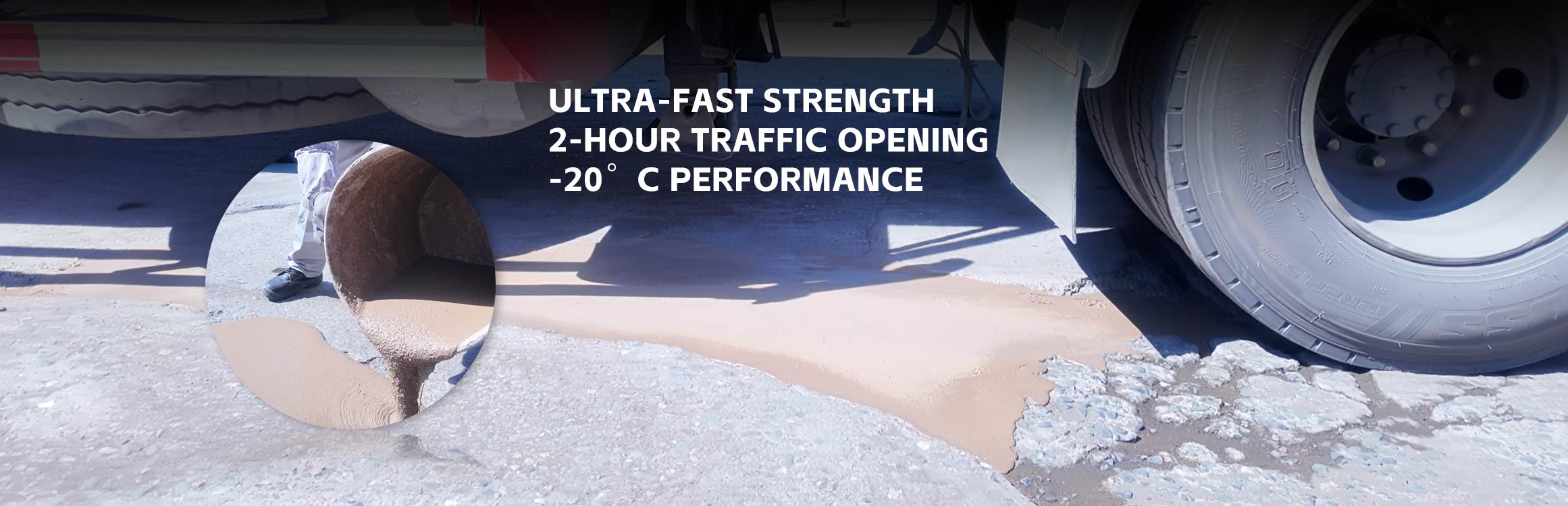
The practical implications for repair applications are significant. A rapid hardening cement MPC system can restore a repaired surface to full traffic loading within 2 to 4 hours of placement — the same timeframe in which a Portland cement repair would still be in its initial set.
Performance Comparison: MPC vs Conventional Repair Materials
| Performance Indicator | OPC-Based Repair Mortar | Rapid Hardening Cement MPC |
|---|---|---|
| Initial Set Time | 45–90 min | 10–30 min |
| 2-Hour Compressive Strength | 2–5 MPa | 20–35 MPa |
| 24-Hour Compressive Strength | 15–25 MPa | 40–60 MPa |
| 28-Day Compressive Strength | 35–50 MPa | 50–70 MPa |
| Shrinkage | Moderate–High | Very Low |
| Bond to Existing Concrete | Moderate | Excellent |
| Service Temperature Range | 0°C to +50°C | -10°C to +50°C |
| Traffic Opening Time | 24–48 hours | 2–4 hours |
The strength advantage at 2 hours is the defining performance differentiator. Most MPC fast setting concrete repair applications achieve load-bearing capacity before a Portland cement repair has even reached initial set.
Technical Parameters
| Parameter | Specification |
|---|---|
| Appearance | Grey to off-white powder |
| Initial Set Time | 10–30 min (adjustable) |
| 2-Hour Compressive Strength | ≥20 MPa |
| 28-Day Compressive Strength | ≥60 MPa |
| Flexural Strength (28-day) | ≥8 MPa |
| Shrinkage (28-day) | ≤0.02% |
| Water Demand | 0.20–0.28 W/B ratio |
| Service Temperature | -10°C to +50°C |
Primary Applications
Magnesium phosphate cement repair mortar is specified across three primary infrastructure repair scenarios where downtime cost justifies premium material selection: airport runway and taxiway patching where FAA or ICAO closure windows are under 4 hours; highway and bridge deck emergency repairs where lane closure costs run into tens of thousands per hour; and industrial floor restoration in food processing, pharmaceutical, and logistics facilities where production schedules cannot accommodate overnight closures.
Frequently Asked Questions
Q: Our existing concrete substrate has active moisture and cannot be dried before repair. Will MPC still bond effectively?Yes — this is one of MPC's genuine advantages over epoxy-based repair systems. Magnesium phosphate cement repair mortar bonds effectively to damp substrates because its phosphate chemistry is not inhibited by surface moisture the way epoxy resins are. The substrate should be saturated surface dry (SSD) condition rather than pooling water, but oven-dry preparation is not required. This makes it particularly suitable for below-grade repairs, tunnel linings, and drainage channel repairs where complete drying is impractical.
Q: We operate in a hot climate where ambient temperatures regularly exceed 40°C. Does MPC set too fast to be workable on site?High ambient temperature is the primary field challenge with rapid hardening cement MPC systems. Above 35°C, the acid-base reaction accelerates and working time can drop below 10 minutes, making placement and finishing difficult. The practical solution is retarder addition — typically borax (sodium tetraborate) at 3 to 8% by weight of MPC — which extends workable time to 20 to 40 minutes without significantly reducing 2-hour or 28-day strength. We provide climate-specific dosage guidance for each project environment as part of our technical support service.
Q: We need the repair to match the color and texture of the surrounding concrete for an architectural application. Is this achievable with MPC?Color matching is more challenging with MPC fast setting concrete repair than with Portland cement systems because MPC's natural color is off-white to light grey rather than the mid-grey of OPC. However, pigment addition is fully compatible with MPC chemistry — iron oxide pigments at up to 5% by weight do not affect setting time or strength development. Surface texture matching requires attention to aggregate selection and finishing technique. We recommend requesting color-matched sample panels before committing to large-area architectural repair work, which we can support with formulation development.
Q: How does MPC perform in freeze-thaw cycling environments? We are specifying for a bridge deck repair in a northern climate.Freeze-thaw durability is an area where magnesium phosphate cement repair mortar demonstrates a measurable advantage over standard OPC repair systems. The low porosity of the MPC matrix — a result of its ceramic-like crystalline microstructure — significantly reduces the water absorption that drives freeze-thaw damage. Independent testing confirms MPC systems typically achieve 300+ freeze-thaw cycles (ASTM C666) with less than 0.1% mass loss, compared to 100 to 150 cycles for standard OPC repair mortars. For bridge deck applications in cold climates, air entrainment at 4 to 6% further enhances freeze-thaw resistance without compromising the early strength gain that makes MPC valuable in this context.
Conclusion
For infrastructure owners and repair contractors where time-to-service is the primary constraint, Magnesium Phosphate Cement delivers a performance profile that no Portland cement system can match. Its combination of 2-hour structural strength, excellent substrate bond, low shrinkage, and freeze-thaw durability makes MPC cement binder the specification choice for airport, highway, bridge, and industrial floor repair applications where every hour of closure carries a measurable cost.