


Why Road Repair Fails Under Heavy Traffic and How Magnesium Phosphate Cement Extends Service Life Significantly
2026-06-23 17:36A road repair that lasts three months is not a repair. It is a recurring cost. For highway maintenance contractors, municipal road authorities, and infrastructure operators across Southeast Asia, Europe, and Asia, the cycle of patching the same pothole or joint failure every season is one of the most persistent operational problems in pavement maintenance. The patch material cures too slowly, cannot open to traffic before it reaches adequate strength, shrinks away from the existing pavement at the edges, or simply cannot withstand the repeated dynamic loading of heavy vehicles before failing again.
Magnesium Phosphate Cement significantly reduces this cycle by delivering strength and bond performance that conventional repair materials cannot match. As a rapid setting pavement repair mortar, MPC road repair material reaches 30 MPa compressive strength in 1.5 hours, bonds to existing concrete at 3.5 MPa, and opens to full heavy vehicle traffic within 0.5 to 3 hours of placement. This article explains the specific pain points that conventional Portland cement repair fails to solve, and why MPC road repair material is the technically correct solution for each one.
What Causes Road Repairs to Fail Repeatedly
Portland Cement Repairs Require Too Long to Cure Before Traffic Reopening
Standard Portland cement repair mortar reaches the minimum compressive strength required for traffic loading, typically 20 MPa, in 24 to 48 hours under normal temperature conditions. On urban arterials, national highways, and airport service roads where lane closure for 24 hours generates significant traffic disruption, economic loss, and public complaints, this cure time is operationally unacceptable.
Contractors under pressure to reopen lanes early apply traffic loading before the repair has reached adequate strength, causing surface crushing, edge spalling, and premature debonding within days of repair completion. The repair fails not because the material is wrong in principle but because the operational window forces premature loading that the material cannot survive.
MPC road repair material as a concrete road repair material for heavy traffic reaches 30 MPa at 1.5 hours and 55 MPa at 24 hours. This strength development timeline allows lane reopening within 1 to 3 hours of repair completion under normal temperature conditions, eliminating the pressure to load repairs prematurely and the failures that result from it.
Repair Edges Debond and Spall Under Dynamic Load
The interface between a repair patch and the surrounding existing pavement is the most vulnerable point in any road repair. Under repeated dynamic loading from heavy vehicles, stress concentrates at the repair edges. If the bond between the repair material and the existing concrete or asphalt substrate is insufficient, the repair edges lift, crack, and spall progressively until the repair patch fails entirely and the underlying void is exposed again.
Standard Portland cement repair mortar achieves bond strength to existing concrete of 1.0 to 1.5 MPa under ideal substrate preparation conditions. MPC road repair material achieves bond strength of 3.5 MPa to existing concrete substrate, more than double the bond strength of standard Portland cement repair at equivalent substrate preparation quality. This higher bond strength maintains repair edge integrity under repeated heavy vehicle axle loads that would progressively debond lower-strength repair materials.
Cold Weather Stops Conventional Repair Programs Entirely
Portland cement hydration requires minimum substrate and ambient temperatures above 5 degrees Celsius to proceed at acceptable speed. Below this threshold, setting time extends dramatically. Below zero, hydration essentially stops, and repair mortar placed in freezing conditions gains no strength and fails upon thawing.
For road maintenance contractors operating winter repair programs in Northern Europe, Central Asia, and high-altitude markets across Asia, this temperature limitation means that pavement damage that occurs or worsens during winter cannot be repaired until spring, accumulating into a large backlog of deteriorated pavement that requires more extensive and expensive repair by the time conditions allow conventional repair to proceed.
Magnesium Phosphate Cement hardens normally at temperatures as low as minus 20 degrees Celsius without heating equipment, insulated blankets, or chemical antifreeze admixtures. Winter road repair programs using MPC road repair material can proceed continuously regardless of ambient temperature, reducing seasonal repair backlogs and preventing minor damage from deteriorating into more extensive structural failures during the winter period.
Repair Mortar Shrinks Away from Patch Edges
Portland cement repair mortar undergoes drying shrinkage of 0.04 to 0.08 percent over the first 28 days of curing. In a constrained repair patch surrounded by existing rigid pavement, this shrinkage pulls the repair material away from the patch edges, creating gaps that allow water infiltration, freeze-thaw damage in cold climates, and progressive edge spalling under traffic.
MPC road repair material exhibits approximately 0.1 percent controlled volumetric expansion after hardening rather than shrinkage. This slight expansion maintains contact between the repair material and the surrounding existing pavement at the patch edges throughout the curing process, reducing the edge gap formation that allows water entry and accelerates repair deterioration.
| Performance Parameter | Portland Cement Repair | MPC Road Repair Material |
|---|---|---|
| Compressive strength at 1.5 hours | 2-5 MPa | 30 MPa |
| Compressive strength at 28 days | 30-45 MPa | 75-85 MPa |
| Bond strength to concrete | 1.0-1.5 MPa | 3.5 MPa |
| Drying shrinkage | 0.04-0.08% | -0.040% (slight expansion) |
| Minimum application temperature | 5°C | -20°C |
| Traffic reopening time | 24-48 hours | 0.5-3 hours |
How Is MPC Road Repair Material Applied on Site
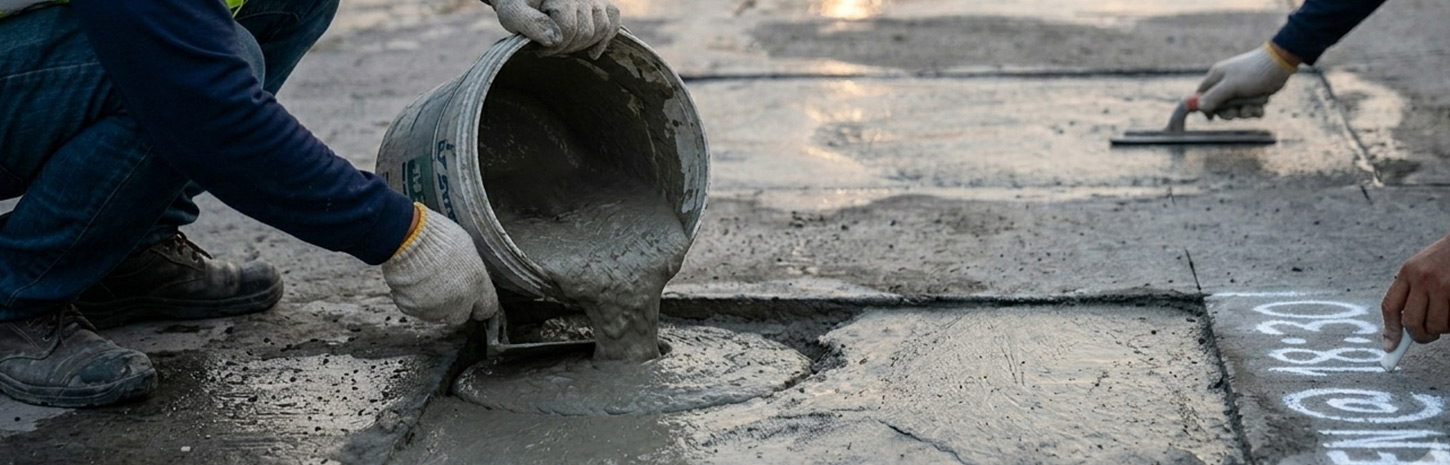
MPC road repair material can be mixed manually with hand tools for small repairs or mechanically with a paddle mixer for larger patch volumes. The repair area should be saw-cut to clean edges, cleaned of loose material and dust, and dampened but not saturated before placing MPC mortar. Setting time is adjustable: 10 to 20 minutes working time for standard repairs and 25 minutes or more for larger placements where extended working time is needed. No curing compound or protective covering is required after initial set. The repair surface can be opened to pedestrian traffic within 30 minutes and heavy vehicle traffic within 1 to 3 hours depending on ambient temperature and repair volume.
Why EastChem
EastChem is a trusted fast setting road repair supplier providing Magnesium Phosphate Cement to highway maintenance contractors, municipal road authorities, airport facility operators, and infrastructure companies across global markets. Our manufacturing is certified under ISO 9001, ISO 14001, and ISO 45001 systems, and our products meet REACH compliance requirements for European market access.
We supply MPC in standard and high-strength grades with complete technical documentation covering mix design, setting time adjustment, substrate preparation, and application procedures. Qualified buyers can request a product sample and technical data sheet before committing to a supply contract.
Contact EastChem today to request a sample, technical data sheet, or pricing for Magnesium Phosphate Cement for your road repair program.
Frequently Asked Questions
How quickly can traffic reopen after MPC road repair?
MPC road repair material reaches 30 MPa compressive strength at 1.5 hours after placement under standard temperature conditions. Pedestrian traffic can reopen within 30 minutes. Light vehicle traffic can reopen within 1 hour. Heavy vehicle and truck traffic can reopen within 1.5 to 3 hours depending on ambient temperature and repair volume. These timelines assume adequate substrate preparation and correct mix water ratio.
Can MPC be used to repair both concrete and asphalt roads?
MPC road repair material bonds directly to existing concrete pavement at 3.5 MPa bond strength. For asphalt pavement repair, MPC is used as a rigid patch material in areas of localized structural failure where a rigid repair is preferred over flexible asphalt patching, such as utility cut reinstatement, bridge deck patching at expansion joints, and areas subject to heavy static loads from parked vehicles or equipment.
What is the shelf life of MPC road repair material?
MPC road repair material in sealed original packaging has a shelf life of 12 months when stored in a dry environment away from moisture. Exposure to humidity during storage can cause premature reaction between the magnesium oxide and phosphate components, reducing working time and early strength development. Storage in weatherproof conditions on a raised pallet away from ground moisture is recommended.
Does MPC require special equipment for mixing and application?
No specialized equipment is required. MPC can be mixed manually with a trowel or shovel for small repairs, or with a standard electric paddle mixer for larger volumes. Standard road repair tools including saws, grinders, and hand compaction equipment are sufficient for substrate preparation and repair placement. No curing compound, heating equipment, or protective covering is required after placement.