


Magnesium Phosphate Cement for Airport Runway Repair: Strength, Speed, and Service Return Within Hours
2026-07-20 15:58Every hour an airport runway is closed for maintenance represents flight cancellations, aircraft diversions, revenue loss for airlines and airport operators, and disruption for passengers across the route network. For airport pavement maintenance engineers and airfield contractors across Southeast Asia, Europe, and Asia, the technical specification of the repair material used for runway spalling, joint failure, and FOD damage determines whether a maintenance window closes on schedule or extends into peak operating hours. Magnesium Phosphate Cement is the rapid setting airfield pavement repair mortar that consistently delivers the strength, bond, and surface finish required for aircraft loading within the shortest available maintenance window.1
Why Standard Repair Materials Fail on Airport Runways
Airport runway repair presents constraints that eliminate standard Portland cement repair mortar and limit the practical application of epoxy systems in most airfield maintenance scenarios.
Portland cement repair mortar requires 24 to 48 hours to reach the compressive strength required for aircraft wheel loading, typically specified at 20 to 28 MPa minimum for general aviation and 35 MPa for heavy commercial aircraft operations. An overnight maintenance window of 6 to 8 hours between last landing and first departure is the maximum time available at most commercial airports without causing flight schedule disruption. Portland cement cannot reach structural loading strength within this window under any practical curing condition without steam or heat curing equipment that is not available at most airport maintenance facilities.
Epoxy repair compounds reach adequate strength within 4 to 12 hours depending on temperature and product grade, which makes them more practical for overnight maintenance windows than Portland cement. However, epoxy systems require dry substrate conditions that are difficult to guarantee in tropical climates across Southeast Asia where overnight humidity and condensation are constant, and epoxy softens significantly above 60 degrees Celsius, which is regularly exceeded on dark pavement surfaces in direct sun in tropical and subtropical airfield environments. Epoxy also requires two-component mixing with pot life management that adds application complexity and failure risk in field maintenance conditions.
What Makes MPC the Correct Specification for Airfield Repair
Strength Development That Meets Aircraft Loading Requirements
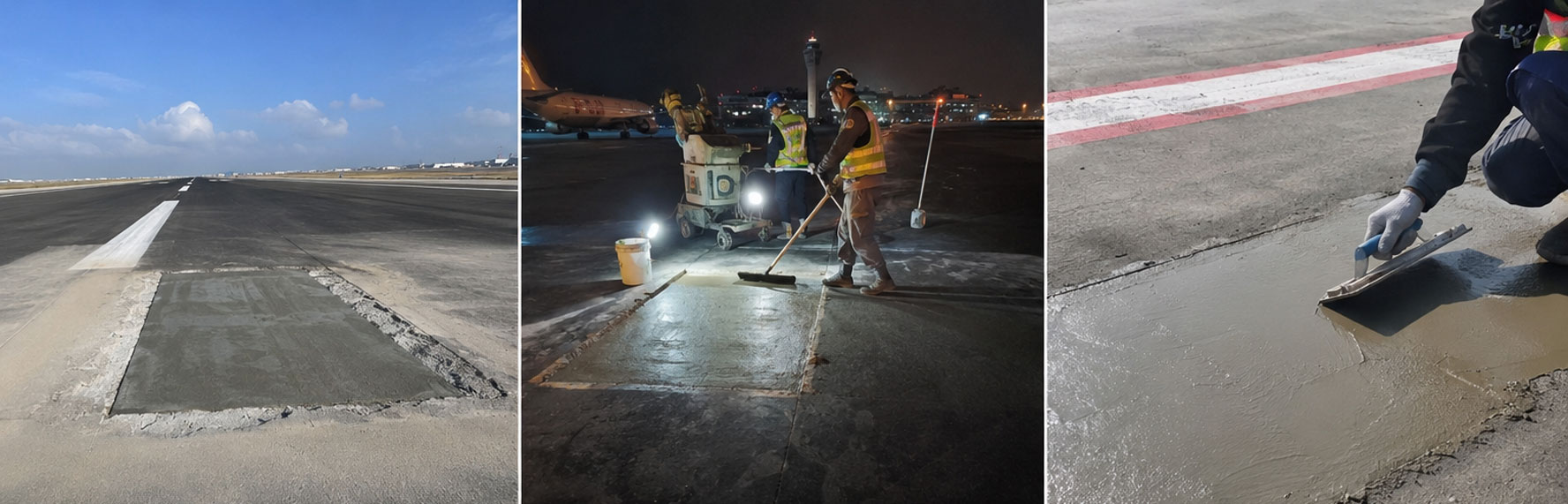
MPC for airport runway repair reaches 30 MPa compressive strength at 1.5 hours after placement, 55 MPa at 24 hours, and 75 MPa at 28 days. Aircraft loading strength requirements of 20 to 28 MPa for regional aircraft and 35 MPa for wide-body commercial operations are met within 1.5 to 3 hours of MPC placement under standard temperature conditions. This strength development timeline allows complete repair sequences including substrate preparation, MPC placement, finishing, and surface marking restoration to be completed within a standard overnight maintenance window of 6 to 8 hours, with the repaired area available for aircraft operations before first departure.
For emergency FOD damage repairs during aircraft turn-around periods at busy airports where closure time is measured in minutes rather than hours, rapid setting airfield pavement repair mortar grade MPC with accelerated setting time of 10 to 15 minutes and structural strength above 20 MPa within 45 minutes allows single-bay repairs to be completed and cleared for aircraft operations within the turnaround window of a parked aircraft.
Bond Strength That Withstands Repeated Aircraft Wheel Loading
Airport pavement repair patches are subject to repeated dynamic loading from aircraft wheels with tire pressures of 1.0 to 1.8 MPa and wheel loads of 20 to 50 tonnes on heavy commercial aircraft. This repeated loading concentrates stress at the interface between the repair patch and the surrounding existing pavement, progressive debonding of repair edges under repeated loading cycles is the primary failure mode of airport concrete repairs that fall short of bond strength requirements.
MPC achieves bond strength to existing concrete pavement of 3.5 MPa, more than double the 1.0 to 1.5 MPa achievable with Portland cement repair at equivalent substrate preparation. This high bond strength maintains repair edge integrity under repeated heavy aircraft wheel load cycles, significantly extending the service life of MPC repairs compared to Portland cement patches in equivalent airfield pavement conditions.
Cold Weather and High Altitude Airfield Performance
Mountain airports and high-altitude airfields across Asia, Central Asia, and Northern Europe operate in temperature conditions that eliminate Portland cement repair entirely during winter maintenance periods. MPC hardens normally at temperatures as low as minus 20 degrees Celsius without heating equipment, insulated blankets, or chemical antifreeze admixtures, making it the only practical rapid setting airport concrete repair material fast strength solution for winter airfield maintenance programs.
For airports at elevations above 2000 meters where overnight temperatures regularly fall below minus 10 degrees Celsius during winter, MPC is the specified repair material for runway and taxiway maintenance because no alternative achieves structural strength within the available maintenance window at these temperatures.
Volume Stability for Joint and Crack Repair
Airport pavement expansion joints and transverse cracks are vulnerable points where concentrated thermal movement and aircraft wheel load transfer generate progressive deterioration. Portland cement repair mortar shrinks by 0.04 to 0.08 percent during curing, which in restrained joint repair applications generates tensile stress at the repair edges and opens gaps that allow water and FOD ingress. MPC exhibits slight volumetric expansion of approximately 0.1 percent after hardening, maintaining intimate contact with joint faces throughout the curing process and eliminating the edge gaps that accelerate joint repair deterioration under traffic.
Application Guidance for Airport Runway MPC Repair
Substrate preparation follows standard airfield repair practice: saw-cut repair boundaries to minimum 50 mm depth with clean vertical faces, remove all loose material by mechanical means, clean the repair area of fuel, rubber, and dust contamination, and dampen the substrate immediately before MPC placement. Setting time adjustment is critical for airfield repairs: for repairs smaller than 0.5 cubic meters, 10 to 20 minute working time is appropriate. For larger joint repairs or slab replacement sections, retarder addition to achieve 25 to 30 minutes working time allows complete placement and finishing before initial set.
Surface finishing to match adjacent pavement texture should be completed before initial set as MPC becomes difficult to work after setting begins. Burlap drag or broom finish matching the existing runway surface texture is applied during the workable period. Surface marking and line painting can be applied within 2 to 4 hours of final set without adhesion problems.
Why EastChem
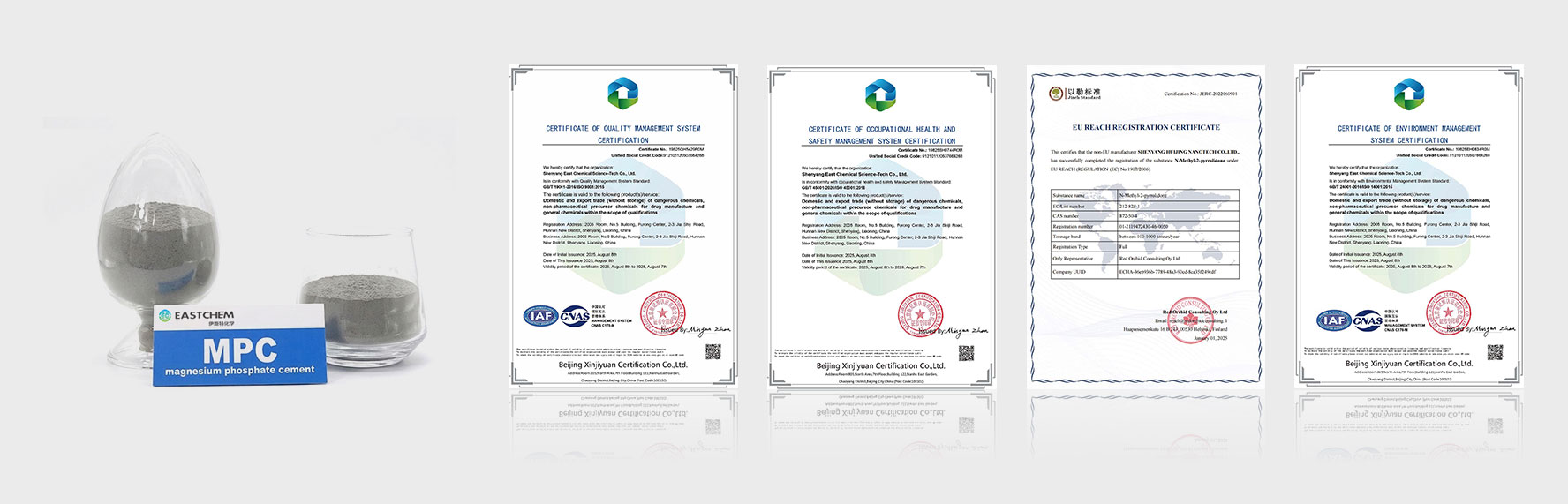
EastChem is a trusted airfield pavement repair material supplier providing Magnesium Phosphate Cement to airport facility operators, airfield maintenance contractors, and civil engineering companies across global markets. Our manufacturing is certified under ISO 9001, ISO 14001, and ISO 45001 systems, and our products meet REACH compliance requirements for European market access.
We supply MPC in standard and rapid setting grades with complete technical documentation including mix design guidance, setting time adjustment, substrate preparation requirements, and surface finishing procedures specific to airfield pavement repair applications. Qualified buyers can request a product sample and technical data sheet before committing to a supply contract.
Contact EastChem today to request a sample, technical data sheet, or pricing for Magnesium Phosphate Cement for your airport runway repair program.
Frequently Asked Questions
How quickly can an airport runway reopen after MPC repair?
MPC reaches 30 MPa compressive strength at 1.5 hours after placement under standard temperature conditions of 15 to 25 degrees Celsius. Light aircraft operations can typically resume within 2 hours and heavy commercial aircraft operations within 3 hours of repair completion, subject to airport authority approval and local pavement strength requirements. Emergency rapid setting grades achieve 20 MPa within 45 minutes for turnaround-window repairs.
What surface preparation is required for MPC airport runway repair?
Repair boundaries should be saw-cut to minimum 50 mm depth with vertical faces to prevent feathered edges. All loose, contaminated, and deteriorated concrete should be removed by scarification or mechanical means. Fuel, rubber deposit, and dust contamination should be removed by cleaning before MPC placement. The substrate should be dampened but not saturated immediately before placement. Unlike epoxy systems, MPC does not require a bonding primer or dry substrate conditions.
Can MPC be used for both concrete and asphalt runway repair?
MPC is primarily specified for Portland cement concrete pavement repair on runway and taxiway surfaces. For asphalt runway surfaces, MPC is used as a rigid repair material in areas of localized structural failure, utility cut reinstatement, and joint repair where a rigid patch is preferred over flexible asphalt patching. Compatibility between the rigid MPC patch and the surrounding flexible asphalt should be evaluated for each specific repair geometry and loading condition.