


Polycarboxylate Superplasticizer Powder for Self-Compacting Concrete: Achieving Flow Without Segregation
2026-04-28 17:48Self-compacting concrete is one of the most technically demanding mix designs in modern construction. It must flow freely under its own weight to fill complex formwork and pass through congested reinforcement without vibration — while simultaneously resisting segregation and bleeding that would compromise the homogeneity of the hardened structure. These two requirements pull in opposite directions, and balancing them demands an admixture with precision-engineered dispersing characteristics that standard superplasticizers cannot reliably deliver.
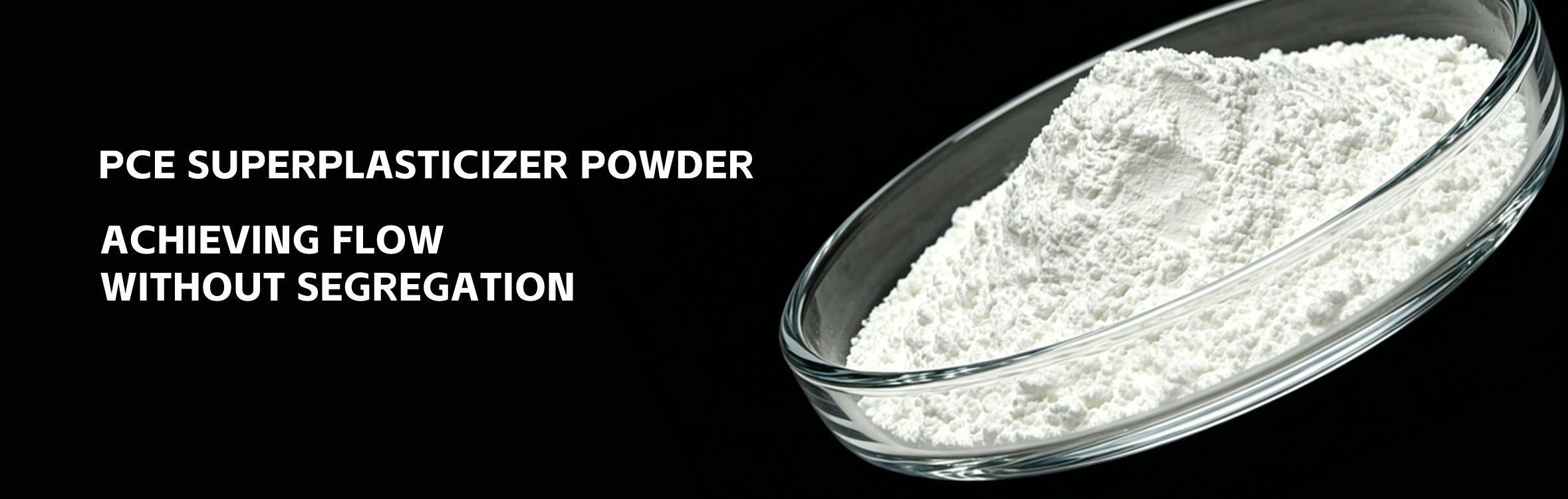
Polycarboxylate Superplasticizer Powder is the admixture that makes SCC practically achievable at commercial scale. Its comb-shaped polymer architecture delivers the high initial fluidity SCC requires while maintaining the viscosity profile that prevents aggregate settlement and paste separation — the combination that defines a stable, specification-compliant self-compacting mix.
Why SCC Places Unique Demands on PCE Chemistry
In conventional vibrated concrete, workability and segregation resistance are managed separately — admixture controls flow, and mechanical vibration consolidates the mix. In SCC, both must be achieved simultaneously through mix design alone. This places requirements on PCE superplasticizer powder that go beyond simple water reduction.
Standard high-range water reducers produce high fluidity by reducing yield stress — but without sufficient viscosity modification, the result is a mix that flows freely but segregates rapidly as aggregate settles through the paste. SCC requires a PCE that reduces yield stress while maintaining adequate plastic viscosity — a balance achieved through careful molecular weight selection and side-chain density in the polymer architecture.
Polycarboxylate ether superplasticizer powder grades optimized for SCC use higher molecular weight polymer with longer polyethylene oxide side chains than standard PCE grades. This produces greater steric hindrance between cement particles — reducing yield stress effectively — while the denser polymer network contributes to the viscosity profile that keeps aggregate suspended through placement.
Technical Parameters
| Parameter | Specification |
|---|---|
| Appearance | Free-flowing white powder |
| Solid Content | ≥95% |
| Water Reduction Rate | ≥28% |
| Slump Flow (SCC target) | 600–750 mm |
| T500 Flow Time | 2–5 seconds |
| Recommended Dosage | 0.15–0.40% by weight of binder |
| Chloride Ion Content | ≤0.1% |
| Shelf Life | 12 months (dry, sealed storage) |
SCC Performance Criteria Met by PCE Powder
| SCC Performance Indicator | Requirement | PCE Powder Achievement |
|---|---|---|
| Slump Flow (EN 12350-8) | 550–850 mm | 600–760 mm |
| T500 Flow Time | 2–5 seconds | Within range |
| V-Funnel Time (EN 12350-9) | 6–12 seconds | 7–11 seconds |
| L-Box Ratio (EN 12350-10) | ≥0.80 | ≥0.85 |
| Segregation Resistance | No visible bleeding | Confirmed |
| 28-Day Compressive Strength | Per design grade | +10–15% vs OPC baseline |
Why Powder Format Is Preferred for SCC Production
For SCC produced at ready-mix plants or precast facilities in markets where liquid admixture supply chain reliability is inconsistent, PCE powder self compacting concrete admixture format offers specific practical advantages that directly affect mix consistency.
Liquid PCE concentration varies with temperature — density changes between summer and winter storage conditions mean that volume-dosed liquid admixtures deliver different active polymer quantities across seasons without careful correction. PCE powder eliminates this variable entirely. Weight-based dosing of superplasticizer powder SCC concrete grades delivers identical active content regardless of ambient temperature or storage duration — a critical consistency requirement when SCC mix design tolerances are tight and out-of-specification flow results in rejected pours.
Powder format also simplifies quality control at goods receipt. A single viscosity measurement on a reconstituted solution confirms active content and batch consistency — a faster and more reliable check than the density and refractive index measurements required for liquid PCE verification.
Frequently Asked Questions
Q: Our SCC mix is achieving target slump flow in the lab but segregating on site during placement into deep columns. The PCE dosage and mix design are unchanged. What is causing this?Segregation in site conditions that does not appear in laboratory testing almost always traces to one of three variables: extended transit time between mixing and placement, higher ambient temperature on site than in the lab, or pumping pressure effects on mix stability. PCE-modified SCC is more sensitive to these variables than vibrated concrete because the mix is designed to operate at the edge of its stability envelope. The practical solution is to reduce PCE dosage slightly and introduce a viscosity modifying agent at 0.01 to 0.03% — this tightens the stability window without sacrificing the flow required for column filling. We provide SCC mix design support for exactly these site-specific scenarios.
Q: We are using fly ash at 30% cement replacement in our SCC mix and finding that PCE dosage requirements have increased significantly compared to our OPC-only design. Is this expected and how do we optimize?Yes, this is expected but manageable. Fly ash particles have a different surface chemistry than cement — specifically, their lower aluminate content means they adsorb PCE less aggressively, which can paradoxically increase the total PCE demand in some mix designs as more polymer remains in solution rather than adsorbing onto particle surfaces. The counter-intuitive solution is often to reduce PCE dosage slightly and extend mixing time, allowing better distribution of the available polymer across all particle surfaces. Molecular weight selection also matters — higher molecular weight polycarboxylate ether superplasticizer powder grades typically perform better in high fly ash mixes. We recommend a targeted trial with three dosage levels before finalizing the SCC mix design.
Conclusion
For concrete producers targeting SCC specification compliance, Polycarboxylate Superplasticizer Powder delivers the combination of high water reduction, flow stability, and batch consistency that liquid admixtures and conventional superplasticizers cannot match across varying site conditions. As a dedicated PCE superplasticizer powder supplier, we provide consistent batch quality, full COA documentation, and SCC mix design support for all structural applications.
Contact us to request a free sample, technical data sheet, or SCC mix design consultation.