


Your Concrete Is Setting Too Slowly, Cracking Too Early, and Failing Too Fast. Lithium Carbonate Is Addressing All Three.
2026-05-13 19:10There are three concrete problems that show up repeatedly across construction projects in hot, humid climates and high-speed urban construction environments. Setting time that cannot be controlled tightly enough for rapid formwork cycling. Early strength development that fails to meet stripping schedules. And long-term cracking that appears months after completion in structures that passed every quality check at handover.
These three problems look unrelated. They are not. All three trace back to the same gap in concrete mix design: inadequate chemistry control at the cement hydration level. Lithium Carbonate concrete accelerator addresses all three through a single, precisely dosed addition to the concrete mix — and it does so at dosage levels so small that cost impact is negligible compared to the value of the problems it solves.
Problem One: Setting Time You Cannot Control
On a high-rise project cycling formwork every 48 hours, concrete that sets fifteen minutes later than expected in hot afternoon conditions is a scheduling problem. On a precast production line running two casts per day, concrete that fails to reach stripping strength within the target window means a mold sits idle for an additional shift.
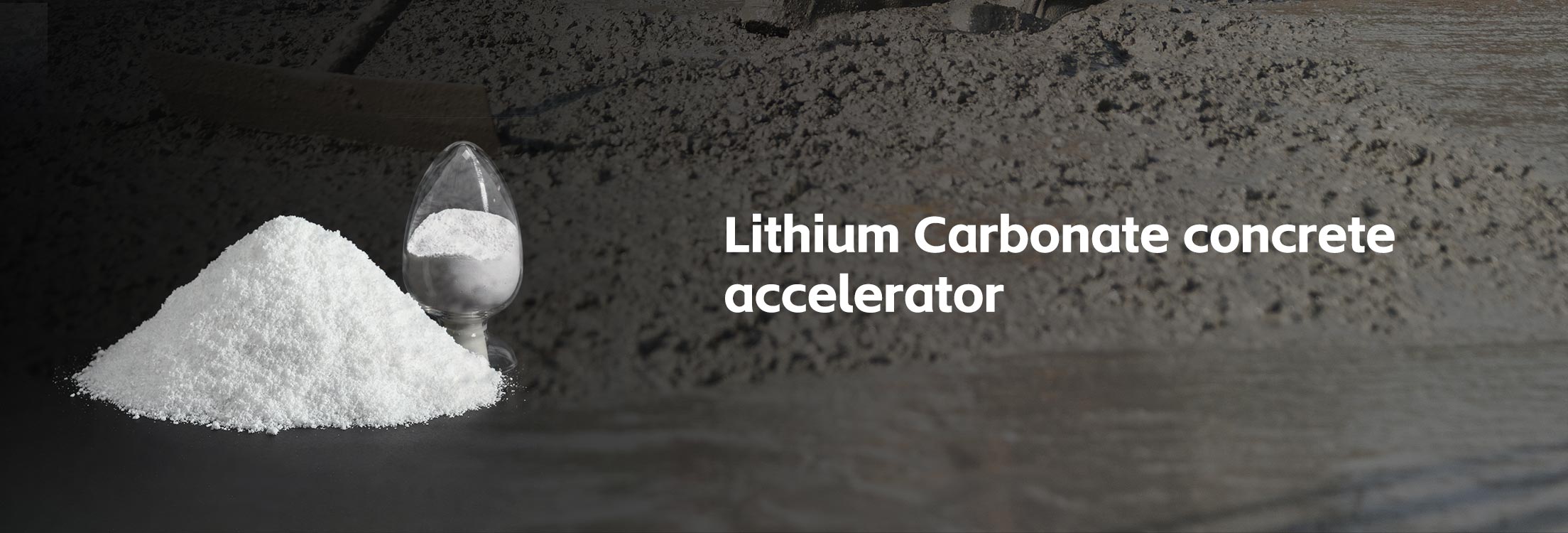
Li2CO3 cement accelerator works by interacting with the aluminate phases of Portland cement — specifically C3A — during the early hydration stage. This interaction catalyzes the formation of ettringite crystals, accelerating initial set and the onset of strength development in a controllable, dosage-dependent way. At 0.05% by weight of cement, the effect is measurable but subtle. At 0.15%, initial set time is reduced by 30 to 45 minutes under standard conditions. The relationship between dosage and set time is predictable enough to dial in to a specific project schedule — something that cannot be said for temperature-dependent accelerators whose performance varies with ambient conditions.
Problem Two: Early Strength That Does Not Meet Schedule
Stripping strength requirements on precast and in-situ structural concrete are typically set at 15 to 20 MPa — achievable at 16 to 24 hours with standard OPC mixes at 20°C. At 35°C this accelerates naturally, but at 15°C or below it can extend to 36 to 48 hours, disrupting production schedules on cold-season projects.
Lithium carbonate concrete early strength enhancement works through two mechanisms simultaneously. The accelerated ettringite formation provides rapid early stiffening. The subsequent promotion of denser C-S-H gel microstructure — the primary strength-giving phase in concrete — produces higher early compressive strength without the long-term strength penalty that calcium chloride and other chloride-based accelerators impose. At 0.10% dosage, 24-hour compressive strength improvements of 20 to 35% have been consistently recorded across multiple cement types and temperature ranges.
| Dosage (% by cement weight) | Set Time Reduction | 24-hr Strength Gain | 28-day Strength |
|---|---|---|---|
| 0.05% | 10–15 min | +8–12% | No change |
| 0.10% | 20–30 min | +20–28% | +3–5% |
| 0.15% | 30–45 min | +28–35% | +5–8% |
| 0.20% | 40–55 min | +30–38% | +5–10% |
Problem Three: Long-Term Cracking That Appears After Handover
This is the problem that damages reputations. A structure passes all quality checks at completion, then develops map cracking across concrete surfaces twelve to thirty-six months after handover. Investigations typically identify alkali-silica reaction — the expansive chemical reaction between alkali ions in the cement pore solution and reactive silica in the aggregate — as the cause.
ASR is a long-term problem that standard concrete mix design does not address unless the aggregate is specifically tested and identified as reactive. In many markets, aggregate reactivity testing is not routine — which means ASR risk is present in a significant proportion of concrete structures without anyone knowing it until the cracking appears.
Lithium carbonate ASR inhibitor function operates through a different mechanism than its accelerating effect. Lithium ions in the concrete pore solution modify the structure of the expansive ASR gel that forms around reactive silica particles, preventing it from absorbing water and swelling. At the dosage levels used for acceleration — 0.05 to 0.20% by weight of cement — lithium carbonate simultaneously accelerates setting and provides meaningful ASR mitigation, without any additional admixture cost.
Technical Parameters
| Parameter | Specification |
|---|---|
| Chemical Name | Lithium Carbonate (Li₂CO₃) |
| CAS Number | 554-13-2 |
| Appearance | White crystalline powder |
| Purity | ≥99.0% |
| Recommended Dosage | 0.05–0.20% by weight of cement |
| pH (1% solution) | 10.5–11.5 |
| Moisture Content | ≤0.5% |
| Shelf Life | 24 months (dry, sealed) |
Why Dosage Precision Requires a Consistent Supply
At dosage levels of 0.05 to 0.20% by weight of cement, small variations in product purity translate directly into performance variation. A lithium carbonate construction additive with 96% purity versus 99% purity produces a measurably different accelerating effect at the same nominal dosage — enough to push stripping strength results below target on a precast production line running tight schedules.
Every batch of our lithium carbonate ships with a COA confirming purity, moisture content, particle size, and pH — verified results from the production batch, not generic specification limits. For concrete producers and precast manufacturers where setting time and early strength are production-critical parameters, this batch-level verification is not optional documentation. It is the quality control input that makes consistent concrete performance possible.